

Summary/Blog: Clays contain hydrophilic minerals like montmorillonite and illite, which significantly influence their geotechnical behavior. These minerals cause substantial volume changes in response to moisture fluctuations, leading to swelling, shrinkage, and potential structural damage. During desiccation, the tensile stresses within the soil can exceed its strength, resulting in cracking. This phenomenon is particularly relevant in geological, geotechnical, geo-environmental, and agricultural engineering. To understand desiccation cracking, it is essential to examine key factors such as mineral composition, layer thickness, specimen size, boundary conditions, compaction state, remolding approach, temperature, humidity, and wet-dry (W-D) cycle frequency. Previous studies highlight the role of boundary conditions, specimen size, and thickness in desiccation cracking. However, there is a lack of comparative research on the cracking and mechanical behavior of compacted clays under varying initial compaction states and W-D cycles.
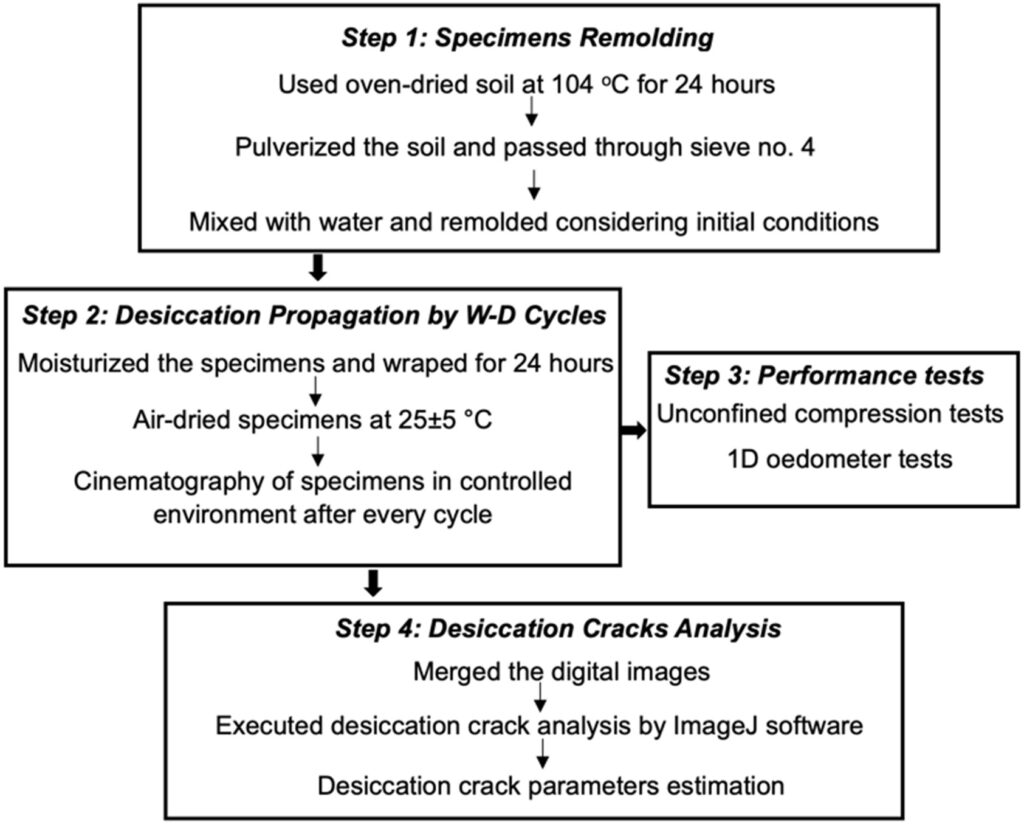
This study investigates desiccation cracking using unbounded cylindrical specimens of three natural clayey soils with distinct physical properties. Two of these soils were sourced from the Indus and Kabul River plains in Khyber Pakhtunkhwa (KPK), near Karak and Nowshera, while the third was collected from the Chenab River plain in Punjab, near Gujranwala. These regions consist of alluvial deposits with fine grains exhibiting varying plasticity levels. The soils were classified according to the Unified Soil Classification System (USCS) based on grain size distribution and consistency limits. The Gujranwala soil was identified as fat clay (CH), the Karak soil as lean clay (CL), and the Nowshera soil as low-plasticity silt (ML). The overall methodology and specimen preparation process are outlined in Figure 1.
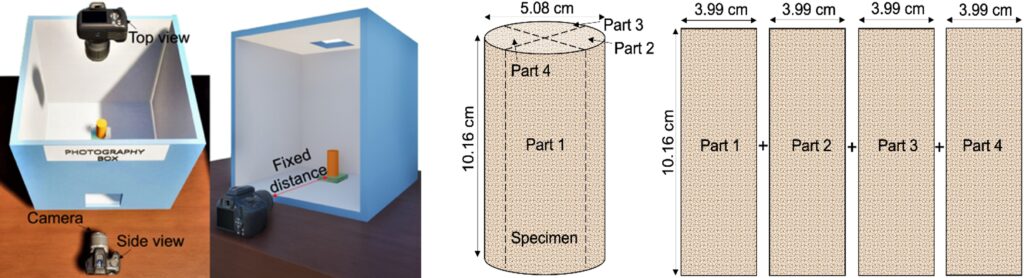
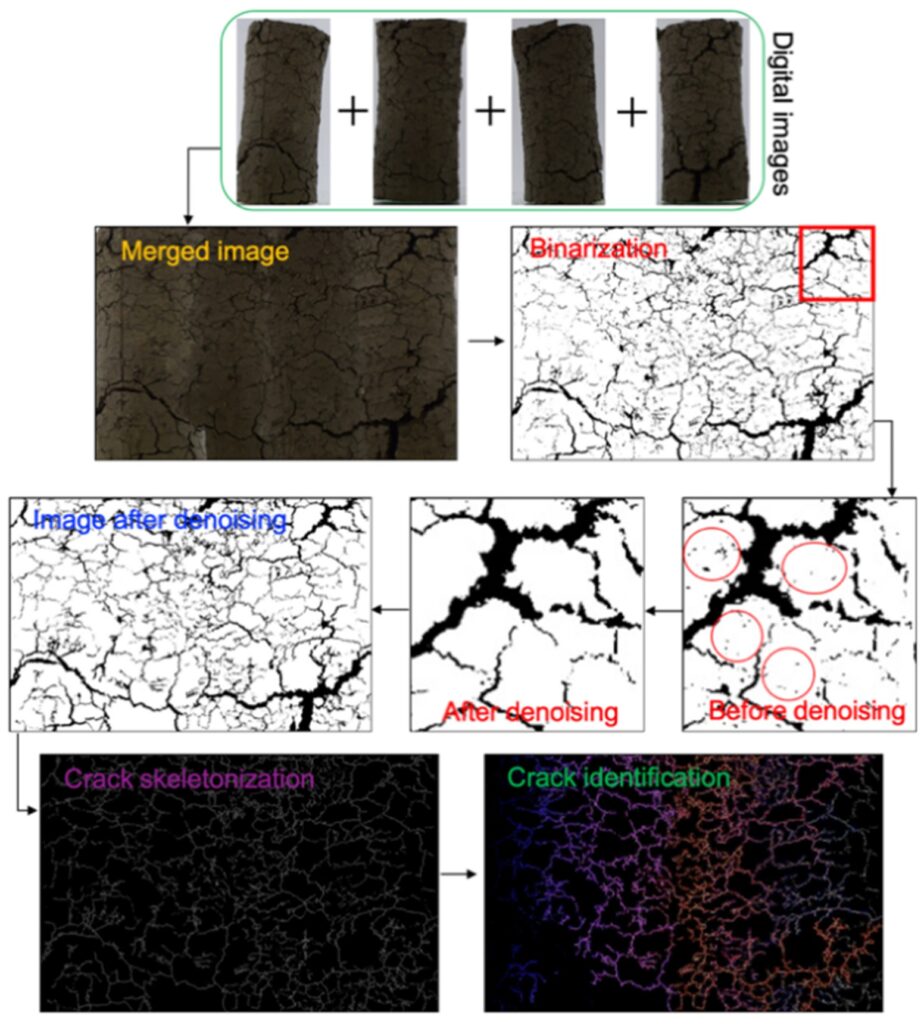
Each specimen underwent four W-D cycles. Wetting was achieved by spraying de-aired water, followed by sealing the specimens with plastic wrap for 24 hours to ensure uniform moisture distribution. After unsealing, specimens were air-dried in a controlled environment (25±5°C, 35±5% RH). The initial drying cycle was considered complete when the water content reached approximately half of the optimum moisture content (wopt), which was monitored at specific intervals using a balance. A standardized setup was used to control image magnification and size. Specimens were photographed from a fixed height, direction, and distance under controlled lighting, with a white backdrop employed to enhance contrast and facilitate image processing (Figure 2). Crack patterns were quantified using ImageJ software before performance testing. The detailed image processing and quantification methodology are presented in Figure 3. Crack area (Ac), perimeter, and total crack length (Ltc) were determined directly from image analysis, while crack surface ratio (Rsc) and crack line density (Dcl) were estimated from the results.
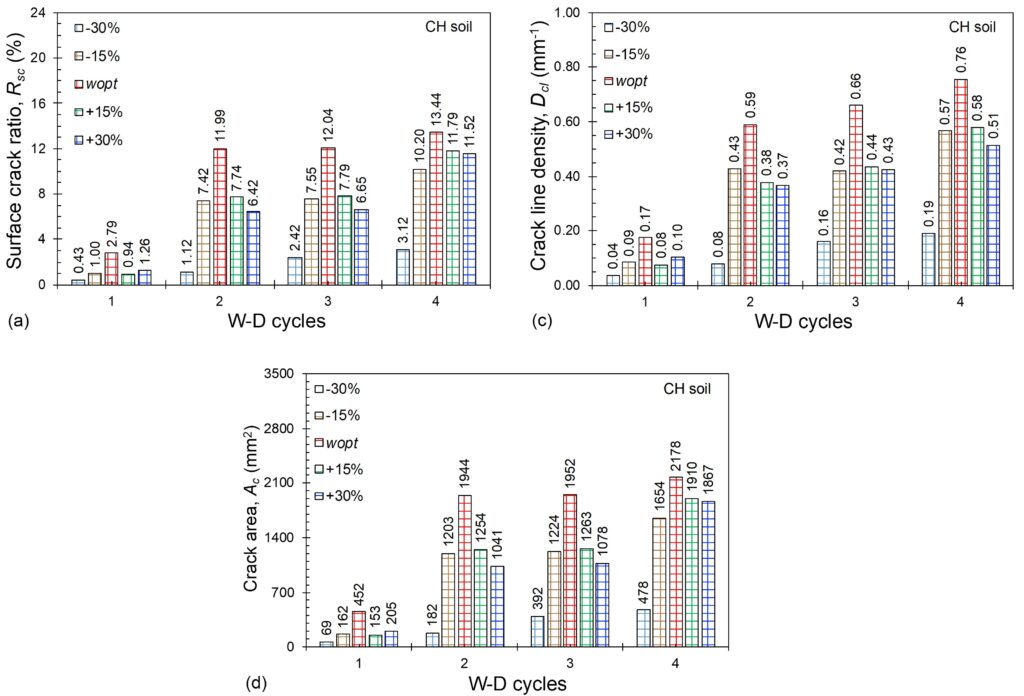
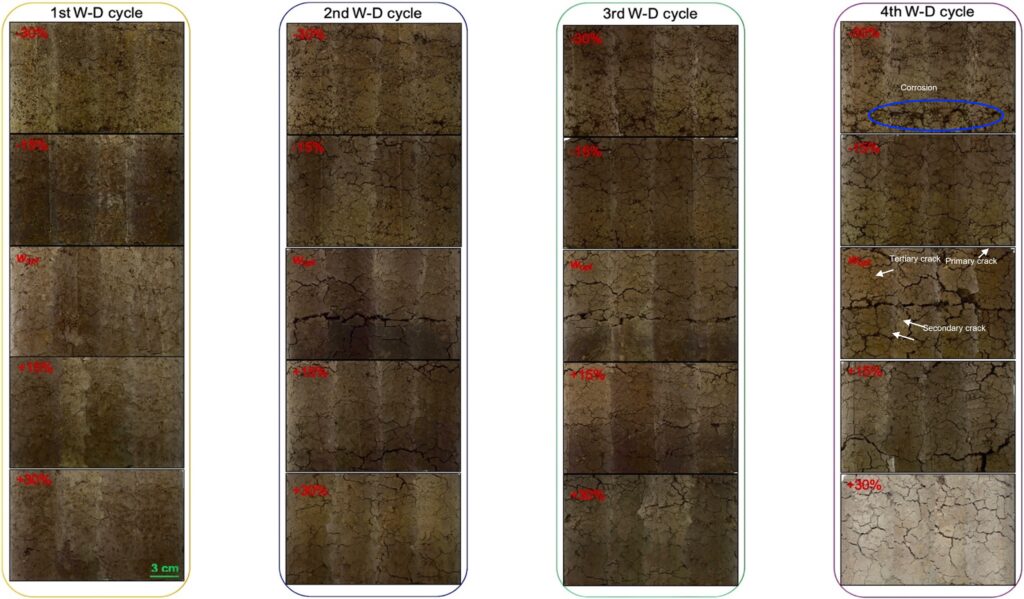
The crack propagation mechanism in CL and CH soils was found to be similar, though CL exhibited a higher tendency for desiccation cracking. The effect of W-D cycles and initial states on crack parameters is discussed in Figures 4 and 5. Cracking initiated after the first W-D cycle but was initially mild. However, its intensity significantly increased after the second cycle and reached an optimal growth rate after the third. While parameters like Rsc, Dcl, and Ac continued growing beyond this stage, Ltc stabilized, indicating a shift from surface cracks to deeper-seated cracks. Clay mineralogy and plasticity played a crucial role in cracking behavior under W-D cycles. CH soil, likely containing 2:1 layered clay minerals, exhibited higher swelling, shrinkage, and cracking parameters than CL soil, which has a 1:1 mineral structure. CH soil experienced maximum cracking at wopt, whereas CL showed minimal desiccation at wopt. ML soil, with lower clay mineral content, exhibited negligible cracking under W-D cycles. The Rsc and Ac values for CH soil were 100-300% higher than those for CL soil, while Dcl and Ltc were 60-130% higher.
Furthermore, the stress-strain response of CH soil shows reduced stiffness with increasing w0 in normal conditions. However, after W-D cycles, stiffness increases due to densification from volume shrinkage, reducing deformability. A similar but less pronounced trend is observed in CL soil. Initial W-D cycles reduce stiffness due to crack induction, affecting subsequent cycles. The qu of CH soil generally decreases with increasing w0 but peaks at wopt. After the first W-D cycle, qu increases due to drying and densification but declines in later cycles due to crack propagation. CL soil follows a similar trend, though with a smaller qu increase due to lower volume shrinkage.
Reference
Shafqat K, Khalid U, Rehman Z (2025). Coupling effect of cyclic wet-dry environment and compaction state on desiccation cracking and mechanical behavior of low and high plastic clays. Bulletin of Engineering Geology and the Environment, 84: 66. https://doi.org/10.1007/s10064-024-04049-2.
The is an Assistant Professor at the National Institute of Transportation (NIT), Risalpur, National University of Sciences and Technology (NUST). He can be research at [email protected].
Research Profile: http://bit.ly/4n5zyCX