
Sufficiency, Efficiency and Renewables – The Pathway to Carbon-neutral Buildings
Step into any bustling city, and you’ll see towering office blocks, shopping malls, hotels, and hospitals. While they serve our daily needs, these commercial buildings also consume massive amounts of energy, often making up over 40% of a city’s electricity demand.
With global climate change accelerating, one question keeps city planners awake at night:
How can we keep our cities thriving while cutting their carbon footprint? Researchers at NUST’s Sustainable Energy Analytics Lab (SEAL) have developed a powerful new tool, UBEM-SER, to help answer exactly that.
UBEM-SER – A City-Scale Building Simulation tool
UBEM-SER represents use of Urban Building Energy Model for implementation of Sufficiency, Efficiency, and Renewable strategies.
It looks at three big ideas:
- Sufficiency: Using only what’s truly needed (avoiding waste like over-lit spaces or extreme heating/cooling).
- Efficiency: Getting more out of every unit of energy (better insulation, efficient equipment).
- Renewables: Generating clean energy locally, especially with building-integrated photovoltaics (BIPV).
What makes UBEM-SER special is that it doesn’t treat these as separate fixes. Instead, it combines all three, showing how they work together for achieving maximum decarbonization in commercial buildings.
Testing the Model – Lessons from Tokyo
To prove UBEM-SER’s potential, this tool is applied to the entire commercial building stock of Chuo City, Tokyo covering 16 million square metres of commercial floor space. Using advanced data sources, like 2.5D GIS building data, equipment surveys, and even travelpatterns, the model simulated how energy is used hour-by-hour across the city.
The Results – Big Cuts in Energy and Emissions
The findings were striking:
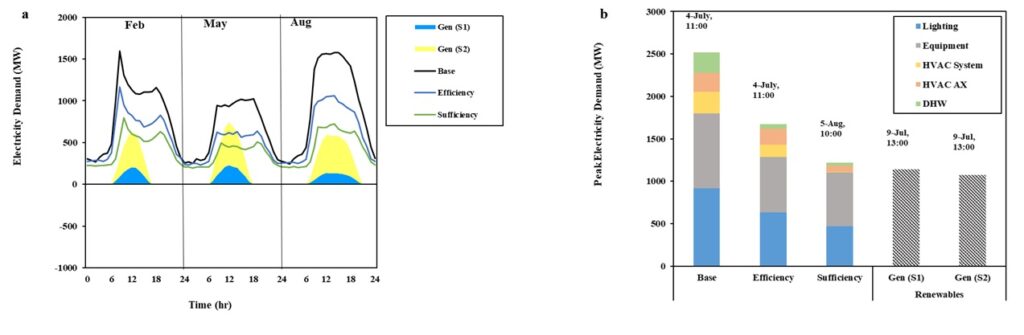
- Energy Use: Combining sufficiency and efficiency cut demand by 60%, dropping annual consumption from 33.5 PJ to 13.6 PJ.
- Peak Electricity Demand: Sufficiency alone reduced peaks by 18%, delaying costly grid upgrades.
- Carbon Emissions: Fell from 4 million tonnes CO₂ to 0.6 million tonnes.
- Renewable Share: Full BIPV implementation pushed self-sufficiency from 15% to 38%.
Perhaps the most important insight: Efficiency delivers the biggest reduction, but sufficiency makes them easier, cheaper, and faster to achieve.
Why this Matters for Pakistan
As Pakistan’s cities expand, energy demand will rise sharply. Without change, this means higher costs, more blackouts, and more emissions.
UBEM-SER offers a data-driven roadmap to avoid that future:
- Policymakers can prioritise the most impactful actions.
- Builders can design projects that meet net-zero standards.
- Cities can plan for resilient, affordable, and comfortable urban spaces.
and because the model is adaptable, it can work for Islamabad, Lahore, Karachi or any city worldwide. The ultimate goal? Cities where buildings use less energy, use it smartly, and power themselves cleanly.
The author is an Assistant Professor at College of Electrical and Mechanical Engineering, National University of Sciences and Technology (NUST). He can be reached at [email protected].
Research Profile: http://bit.ly/3HAy8l6