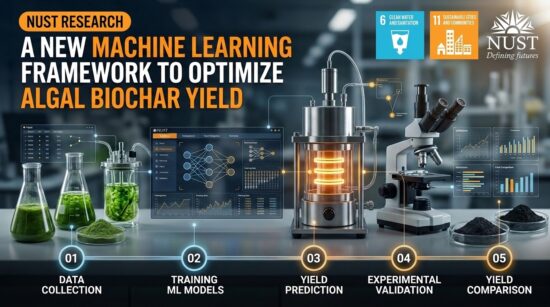
Developing a Machine Learning Framework for Better Biochar Yield

Research NUST researchers develop a machine learning framework for algal biochar yield that reaches 75.42% in lab tests with 1.12% error. Biochar is a carbon rich material produced by heating biomass under oxygen limited conditions, a process known as pyrolysis. It has potential applications in carbon sequestration, soil improvement and renewable energy systems. Algae are…
A New Framework to Protect Solar Investments from Climate and Financial Risks

Research NUST researchers introduce a risk-assessment framework that integrates climate variability, financing and tariff structures to support more resilient utility-scale solar power investments in Pakistan. As countries expand their renewable energy capacity, ensuring the long-term financial and technical viability of solar power projects remains a critical challenge. While solar photovoltaic (PV) systems offer significant potential…

45 Researchers from NUST Ranked in World Top 2% Scientists

Global Rankings 45 NUST researchers feature in the latest Stanford–Elsevier list of the world’s top 2% scientists NUST continues to strengthen its position as a leading research-intensive university, with 45 of its researchers recognized among the world’s top 2% scientists rankings published by Stanford University and Elsevier. The recognition reflects the quality, visibility and international…

Loading

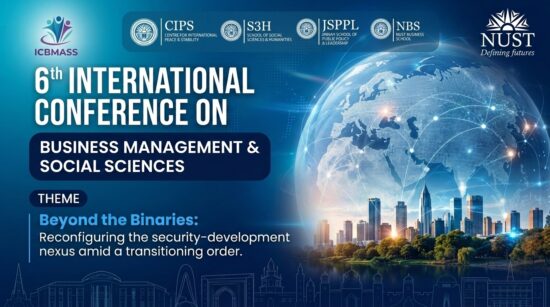
6th International Conference on Business, Management and Social Sciences (ICBMASS-2026)

Conference Report 6th International Conference on Business, Management and Social Sciences (ICBMASS-2026) Theme: Beyond the Binaries: Reconfiguring the Security–Development Nexus amid a Transitioning Global Order Date & Time 21–22 October 2026 Venue & Organizers NUST, Islamabad Overview The 6th International Conference on Business, Management and Social Sciences (ICBMASS-2026) was held on 21–22 October 2026 at…

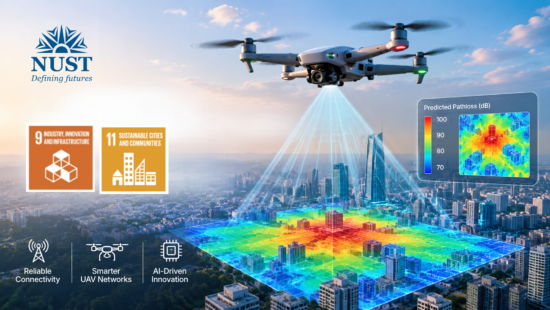
Enhancing UAV Networks Through Multi-Scale U-Net Deep Learning Framework

Research NUST researcher develops a multi scale U-Net deep learning framework that cuts urban millimeter wave signal pathloss prediction error to 3.15 dB for reliable UAV network planning. As unmanned aerial vehicles (UAVs) become increasingly important to next-generation wireless networks, ensuring reliable communication in complex urban environments remains a significant challenge. Buildings, signal obstructions and…

Loading

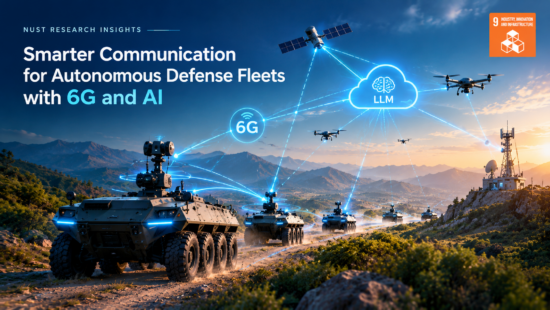
Smarter Communication for Autonomous Defense Fleets with 6G and AI

The 6G–LLM system kept 82.9% of missions successful versus 14.2% for 5G, while cutting latency by 75%. Imagine a convoy of self-driving vehicles moving through contested terrain, where every second of delay matters. Researchers at NUST combined next-generation 6G networks with Large Language Models (LLMs) to help fleets of autonomous defense vehicles share what matters…

Loading