


Access to safe drinking water remains one of the most pressing global challenges of the 21st century. Traditional sources are becoming increasingly unreliable due to climate change, rapid population growth, pollution, and unsustainable extraction practices. In response, researchers are advancing sustainable technologies like Atmospheric Water Generators (AWGs) devices that harvest potable water directly from moisture in the air. AWGs are especially promising for off-grid, disaster-hit, and peri-urban areas because they can be powered by renewables and operate independently of rivers, aquifers, or pipelines.
There are two main technical routes for harvesting water from air, both of which our team at NUST is developing. The first is thermoelectric cooler (TEC)–based condensation, where a solid-state module creates a cold surface; when humid air passes over and cools below its dew point, water condenses and can be collected. TEC systems are compact, free of refrigerants, simple to control, and pair naturally with solar photovoltaic power and a small battery. The second route is adsorptive harvesting using metal–organic frameworks (MOFs). MOFs are highly porous materials that capture water vapor at lower temperatures or higher relative humidity and then release it when gently heated ideally by sunlight or waste heat. The released vapor is directed into a small chamber where it condenses and is collected. In drier climates, well-chosen MOFs can outperform direct condensation by using low-grade solar heat rather than continuous electrical cooling.
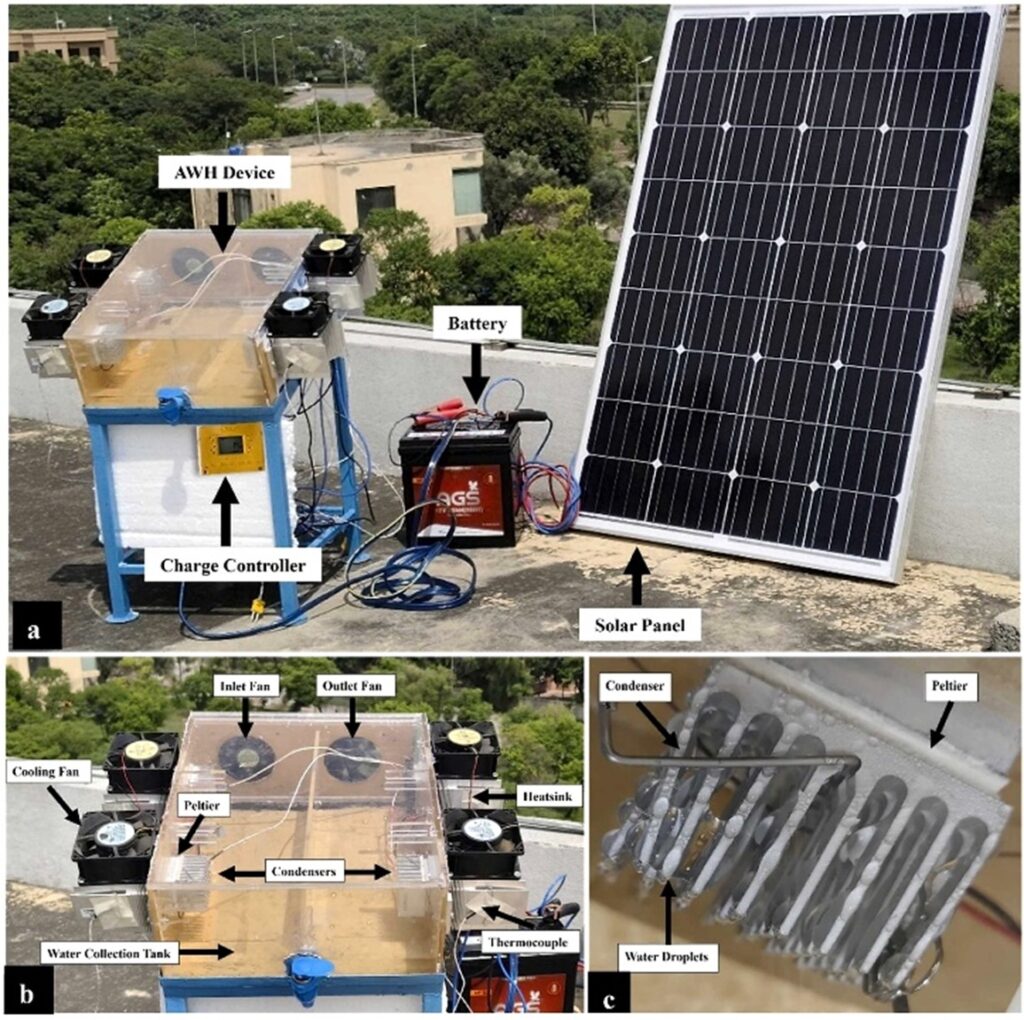
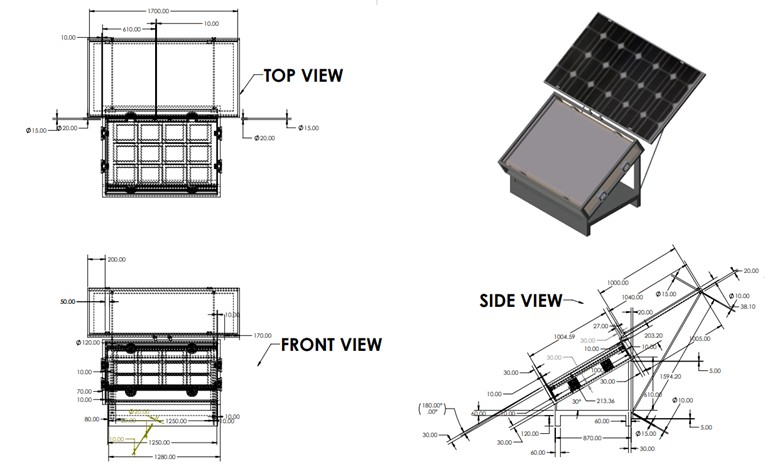
A recent study led by Prof. Dr. Nadia Shahzad and her team at USPCAS-E, NUST, presents a solar-powered AWG prototype that maintains reliable performance in low to moderate humidity, a major step beyond traditional systems that typically require very humid air. Designed specifically for a 35–65% relative humidity window, the system employs four TEC modules in a compact acrylic housing. Each module is integrated with aluminum heat sinks and airflow-assisting fans, and the entire unit is powered by a photovoltaic array with a lithium-ion battery, enabling fully off-grid operation. The design minimizes energy losses, optimizes condensation, and improves year-round usability. A key engineering choice was air-speed optimization: an inlet speed of about 2.9 m/s both enhanced condensation by bringing fresh humid air to the cold surface and mitigated frosting that can impede heat transfer.
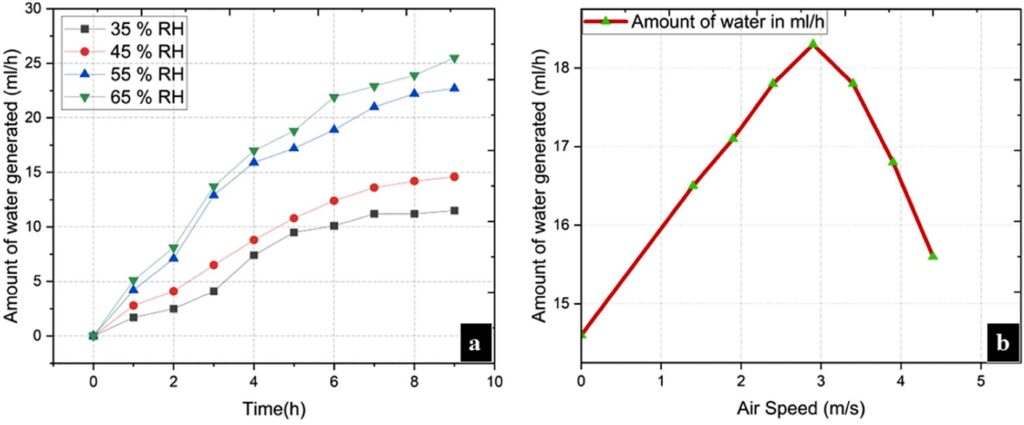
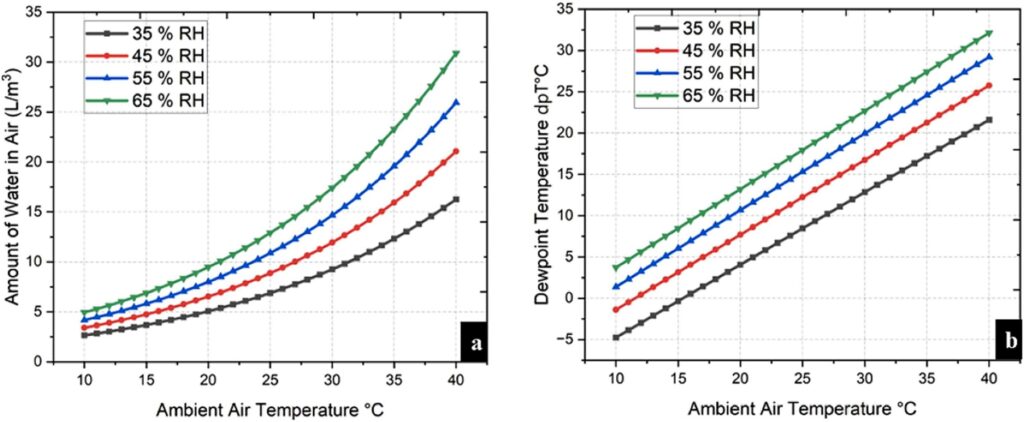
Experimental testing in controlled laboratory chambers and during multi-day outdoor trials in Islamabad demonstrated consistent performance. The prototype achieved a maximum water yield of 25.5 mL/h at 65% RH and 35 °C, while still producing 11.5 mL/h at 35% RH, confirming operational viability in drier conditions typical of many Pakistani cities. Field data showed a clear correlation between ambient relative humidity, proximity to the dew point, and water yield; on days with slightly higher humidity and lower average air temperature, production increased accordingly. The results aligned well with theoretical expectations and earlier modeling, underscoring that careful thermal–airflow design can maintain output without icing in real environments.
Water safety was rigorously assessed. Laboratory analysis of the collected water confirmed that pH (approximately 7.32) and key indicators including nitrate, sulfate, total hardness, dissolved oxygen, and total dissolved solids were within WHO and Pakistan NSDWQ limits, indicating suitability for drinking and household use with standard hygienic handling. Compared with many thermoelectric-based AWGs reported that emphasize very humid sites or rely on grid power, the USPCAS-E design offers a scalable, autonomous solution for water-stressed, low-infrastructure settings. Its modular architecture allows capacity to be scaled to household, institutional, or emergency-response needs without redesigning the core system.
Building on this foundation, the team is advancing an MOF-based pathway centered on MIL-101(Cr) to improve yields at lower humidity and reduce electrical demand. In this approach, the MOF adsorbs water vapor during cooler periods (often at night) and then releases it with low-grade solar heat during the day. The desorbed vapor is directed into a compact condenser for collection. Current engineering work focuses on a thermally managed sorbent bed for rapid cycling, a closed-loop vapor path to minimize losses, and a potential hybrid configuration where a small TEC stage “polishes” the dew-point gap for all season performance. Because MIL-101(Cr) contains chromium, the design includes safe encapsulation and responsible materials handling to ensure durability and user safety across repeated cycles. Together, the TEC and MOF routes create a complementary hybrid platform: precise, on-demand condensation when electricity is available from PV, and solar-thermal adsorption cycles that excel in arid conditions.
In short, decentralized, hybrid AWGs can strengthen climate resilience in Pakistan and water security by providing micro-sources of safe water where infrastructure is weak or disrupted—disaster-response zones, peri-urban settlements, mountainous regions, deserts and coastal belts with brackish groundwater. The research also aligns national sustainability goals by pairing renewable energy with clean-water access, reducing logistical burdens associated with trucking or bottling. The next steps include extended field trials across diverse climatic zones, refinement of MOF formulations and bed design for faster cycling and longevity, and co-development with partners to translate prototypes into robust products.
Reference
Syed Shabir Ahmed, Ranjeet Kumar, Nadia Shahzad, Adeel Waqas, Naveed Hussain, Roha Shahzad, Naseem Iqbal, Muhammad Imran Shahzad, Experimental study of solar-powered atmospheric water generator for extracting potable water from air, Chemical Engineering Research and Design, 219 (2025) 388-396.
The author is Professor at U.S.-Pakistan Center for Advanced Studies in Energy (USPCAS-E), National University of Sciences and Technology (NUST). She can be reached at [email protected].
Research Profile: https://bit.ly/3LFpR0L