
Across the world, industries face mounting pressure to shrink their carbon footprint. Yet, the machines that power our factories — from textile mills to pharmaceutical plants — still rely heavily on fossil fuels, a major source of greenhouse gas emissions. Among them, industrial gas turbines stand out as the workhorses of modern manufacturing. The challenge lies in making them cleaner without compromising performance.
A team of researchers at the National University of Sciences and Technology (NUST), led by Prof. Tahir Abdul Hussain Ratlamwala, has taken on this challenge head-on. Their groundbreaking study, “Decarbonization Pathways for Gas Turbines: A Thermodynamic and Lifecycle Evaluation of Hydrogen and Biogas Blends” (published in the International Journal of Hydrogen Energy, 2025), offers a clear roadmap toward a more sustainable industrial future.
The Energy Dilemma
Every day, thousands of industrial gas turbines convert natural gas into electricity and steam that keep factories running. However, this reliability comes at a steep environmental cost — more than 7.5 billion tons of CO₂ are emitted annually worldwide from natural gas use alone [1].
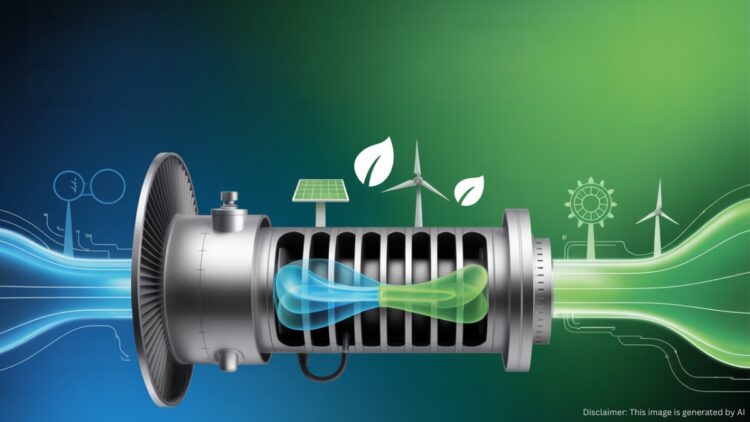
Completely replacing existing systems with renewables isn’t immediately practical. Recognizing this, the NUST team pursued a pragmatic approach: make existing turbines greener. Their mission was simple yet ambitious — reduce emissions without replacing or redesigning the entire turbine.
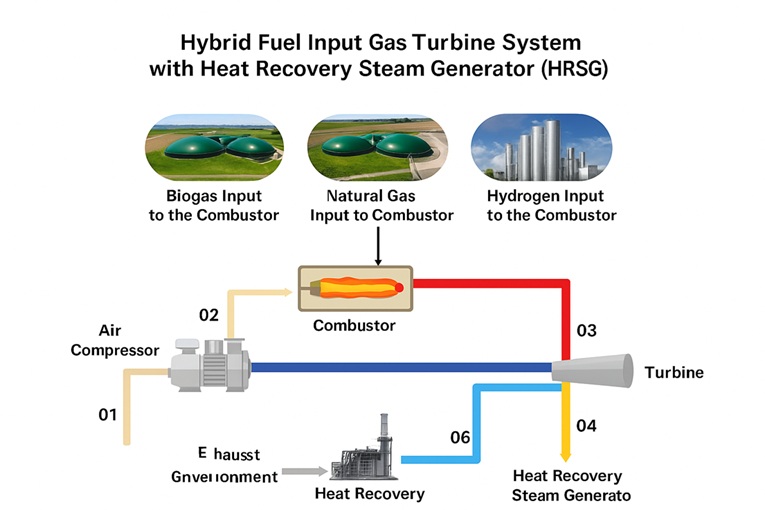
Their case study focused on a 5.5 MW Solar Taurus-60 gas turbine operating at an industrial plant in Karachi. Using this real-world setup, the researchers explored how blending hydrogen and biogas with natural gas could substantially cut emissions while keeping the same power output.
The Innovation: Blending Fuels, Not Compromises
Instead of reinventing the turbine, the researchers reimagined its fuel. They proposed a hybrid mix of hydrogen (a clean-burning fuel) and biogas (produced from organic waste), blending them with natural gas for optimal performance.
Using Engineering Equation Solver (EES) and OpenLCA software with the Ecoinvent 3.10 database, they conducted detailed thermodynamic, exergy, and life cycle assessments (LCA) — a rare combination in studies of industrial-scale gas turbines. This holistic approach mapped out the complete environmental impact, from raw material extraction and turbine manufacturing to operation and end-of-life recycling.
The Results: Hydrogen Wins, Biogas Complements
The findings were both promising and practical:
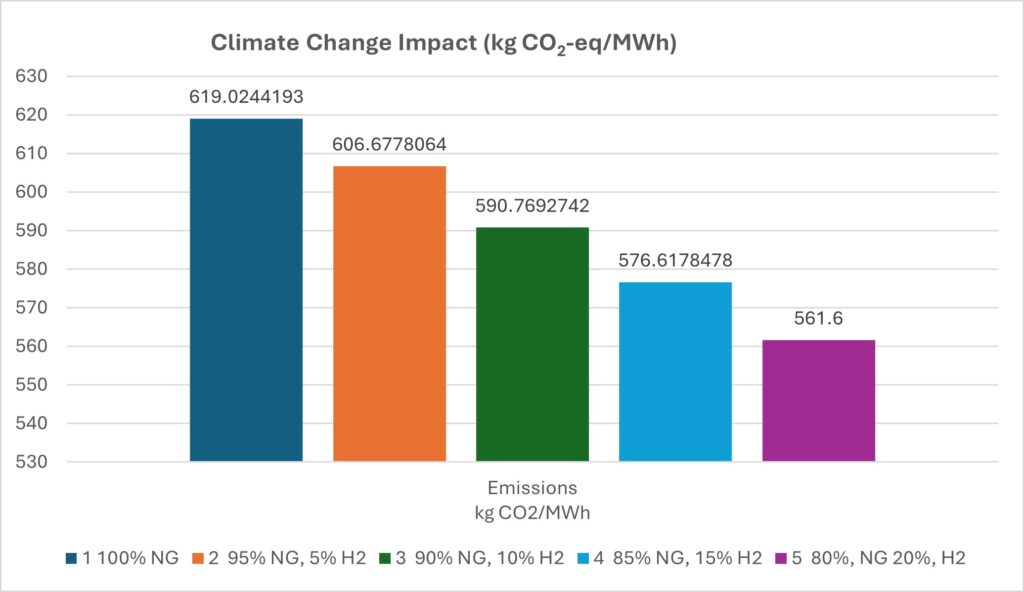
- Baseline (Natural Gas only): 32.75% efficiency, 619 kg CO₂-eq/MWh
- 20% Hydrogen blend: Efficiency rose to 36.79%, emissions dropped to 561 kg CO₂-eq/MWh — a 10% reduction
- 20% Biogas blend: Efficiency fell to 26%, but introduced renewable waste utilization
- Optimal blend (80% NG + 15% H₂ + 5% BG): Efficiency 32.79%, emissions 585.6 kg CO₂-eq/MWh, offering a balanced path to cleaner energy
In short, hydrogen boosts efficiency and reduces emissions, while biogas converts waste into valuable energy. Together, they create a feasible, low-cost route toward industrial decarbonization.
Beyond the Turbine: Measuring True Sustainability
Most studies stop at operational emissions, but the NUST team went further. Through a cradle-to-grave Life Cycle Assessment, they tracked environmental impact across the entire 20-year life of the turbine — including manufacturing a 37-ton gas turbine and a 40-ton Heat Recovery Steam Generator (HRSG), and their recycling at the end of service life.
Their results revealed that fuel combustion accounts for over 99% of total emissions, emphasizing that the choice of fuel blend can make or break decarbonization outcomes.
A Vision for Pakistan’s Clean Energy Future
Pakistan’s industrial sector holds immense potential for carbon reduction, and studies like this illuminate the way forward. The research demonstrates that even modest changes — such as adding just 5% hydrogen — can yield measurable environmental benefits.
These insights provide a guiding framework for policymakers and industrial stakeholders to adopt hybrid energy systems that remain affordable, efficient, and climate-conscious as hydrogen production and biogas utilization expand across the country.
From Research to Reality
Looking ahead, the researchers aim to collaborate with local industries to conduct experimental testing with higher hydrogen ratios and optimize turbine performance under Pakistan’s climatic conditions. This approach bridges academic research with practical implementation, reinforcing NUST’s leadership in developing indigenous, sustainable energy solutions.
About the Research Team
This pioneering study was conducted by Abdul Rafay Khokhar, Prof. Tahir Abdul Hussain Ratlamwala, Prof. Khurram Kamal, Prof. Mohammad Alkahtani, and Engr. Sayem Zafar. The team’s blend of academic expertise and industrial experience underscores a simple truth — the journey to decarbonization can begin locally, with practical, science-driven innovation.
Reference
[1] IEA, World Energy Outlook 2024, International Energy Agency, 2024.
The author is a Professor, at Pakistan Navy Engineering College (PNEC), National University of Sciences and Technology (NUST). He can be reached at [email protected].