
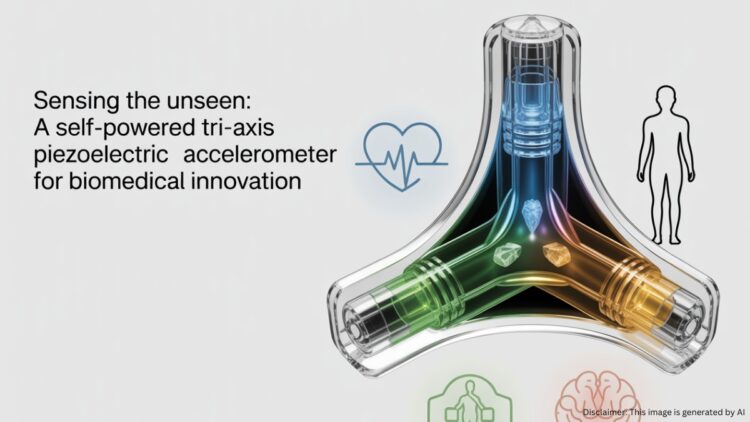

Imagine a world where surgical tools could “feel” the pressure they apply or where wearable devices could monitor movement with surgical precision without needing a power source. At the Department of Mechatronics Engineering, NUST College of EME, Dr. Hassan Elahi and his research team have made a major leap toward this future. Their latest innovation, a new motion sensor that uses special nanowires (tiny structures) made of zinc oxide, promises not just precise motion detection, but also self-powering capabilities that make it ideal for the next generation of biomedical technologies.
The Problem: Limitations in Existing Sensors
Traditional MEMS accelerometers often operate in only one direction and rely heavily on external power sources. For applications like robotic surgery or long-term health monitoring, these limitations can be critical. Most commercially available sensors struggle with either sensitivity, range, or adaptability to three-dimensional motion. Moreover, many require complex circuitry and are not suitable for miniaturized or wearable platforms.
The Innovation: Tri-Axis ZnO Nanowire-Based Piezoelectric Accelerometer
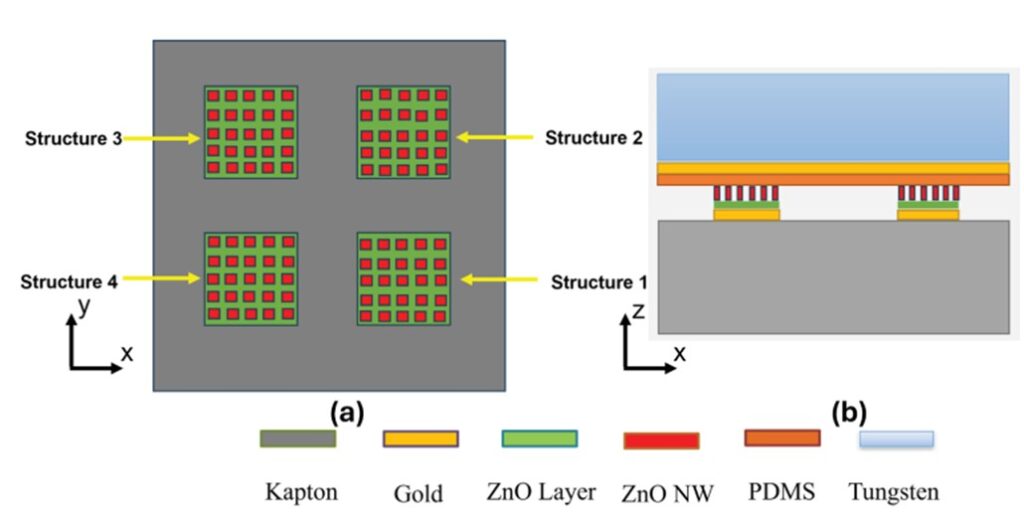
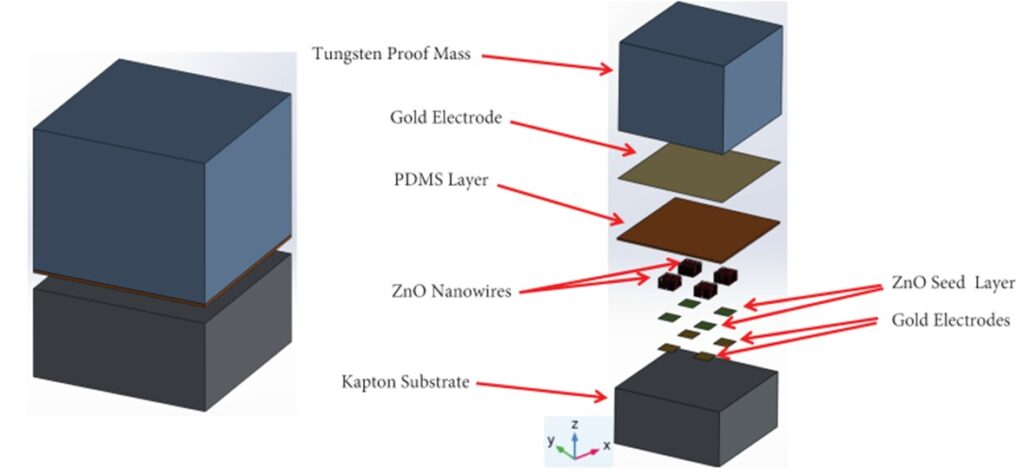
Dr. Elahi’s team has developed a micro-scale accelerometer capable of measuring motion in all three spatial axes (X, Y, Z) built with tiny zinc-oxide wires on a flexible surface, which can generate electricity when bent or pressed. Their unique structure and properties allow them to sense both tensile and compressive stress, providing voltage signals corresponding to motion direction and intensity.
How It Works
When the device moves, the tiny wires inside stretch or compress, producing electrical signals. This causes a change in voltage across electrodes due to the piezoelectric effect. The sensor can distinguish between directions based on the polarity and magnitude of the output voltage. For instance, in the X-axis, two quadrants generate positive voltages while the other two produce negative voltages—clearly identifying the axis and direction of motion.
High Sensitivity and Linear Response
The design was tested using computer simulations, both for small and large movements. The sensor was very sensitive, especially to movements up and down compared to side-to-side. Importantly, the device also demonstrated a highly linear response, essential for reliable and repeatable sensing in real-world applications.
Applications and Impact
This accelerometer is particularly well-suited for biomedical applications, including robotic-assisted surgeries, posture monitoring in rehabilitation, and intelligent prosthetics. Its compact size, flexibility, and ability to generate its own power make it ideal for wearable technologies and implantable devices , where relying on external batteries is difficult.
Beyond medicine, the device shows great potential in aerospace systems, where lightweight, highly sensitive sensors are needed to monitor vibrations and structural health in aircraft. It could also be applied in underwater technologies, such as autonomous submarines or marine exploration devices, where long-term, battery-free sensing is critical.
With this wide range of possibilities, the tri-axis piezoelectric accelerometer stands as a versatile innovation that can reshape not only healthcare but also the future of transportation, exploration, and smart electronics.
A Word from the Researcher “Our goal was to design a sensor that not only performs across three axes with high sensitivity but also eliminates the dependency on external power,” said Dr. Hassan Elahi. “We believe this innovation will pave the way for smarter, more integrated biomedical and wearable systems.”
Conclusion
This work marks a significant step towards truly intelligent and autonomous sensors. By combining advanced materials with smart design, this tri-axis piezoelectric accelerometer opens new doors for safer surgeries, personalized health monitoring, and futuristic wearable electronics. With further development, the team envisions integrating this technology into next-generation medical devices and AI-powered sensor platforms.
The author is an Associate Professor at College of Electrical and Mechanical Engineering (CEME), National University of Sciences and Technology (NUST). He was also listed among the world’s top 2% of scientists for his impactful research contributions in 2025. He is a leading expert in piezoelectric materials, advanced sensors and actuators, aerospace structures, and cutting-edge underwater applications. His work has gained wide recognition for pushing the boundaries of innovation in these fields. He can be reached at [email protected].
Research Profile: https://bit.ly/49h4Z9Z