
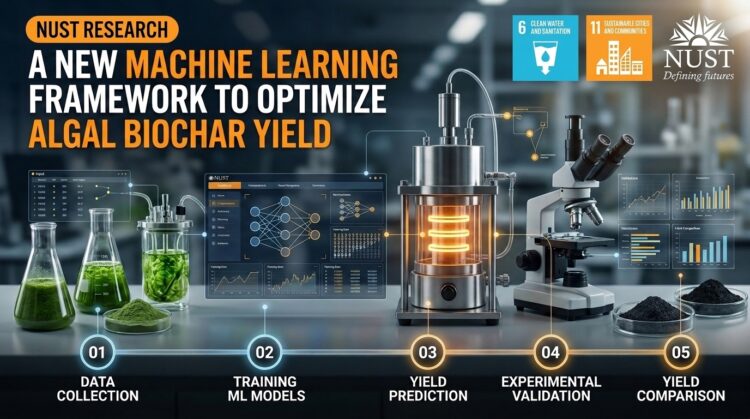
NUST researchers develop a machine learning framework for algal biochar yield that reaches 75.42% in lab tests with 1.12% error.


Biochar is a carbon rich material produced by heating biomass under oxygen limited conditions, a process known as pyrolysis. It has potential applications in carbon sequestration, soil improvement and renewable energy systems. Algae are an emerging feedstock for biochar production because they are widely available and require relatively little land. However, their varying chemical composition and moisture content make it difficult to consistently predict production yields.
Machine Learning Optimization for Algal Biochar Yield
Researchers at the National University of Sciences and Technology (NUST) have developed a machine learning framework to predict and optimize biochar production from algal biomass. Published in Biochar (2026), the study brings together researchers from NUST’s School of Chemical and Materials Engineering and the U.S. Pakistan Centre for Advanced Studies in Energy, alongside international collaborators, combining published data with experimental validation to reduce trial and error experimentation.
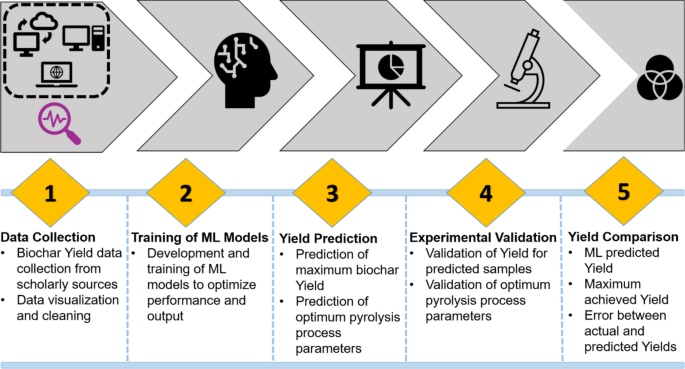
To address this challenge, the research team developed and compared four machine learning models: Ensemble Trees (ET), Gaussian Process Regression (GPR), Decision Trees (DT) and Support Vector Machines (SVM). The models were trained using a dataset of 373 experimental observations compiled from 48 research publications, incorporating algal composition (carbon, nitrogen and moisture content) alongside processing variables such as pyrolysis temperature, heating rate, residence time and particle size.
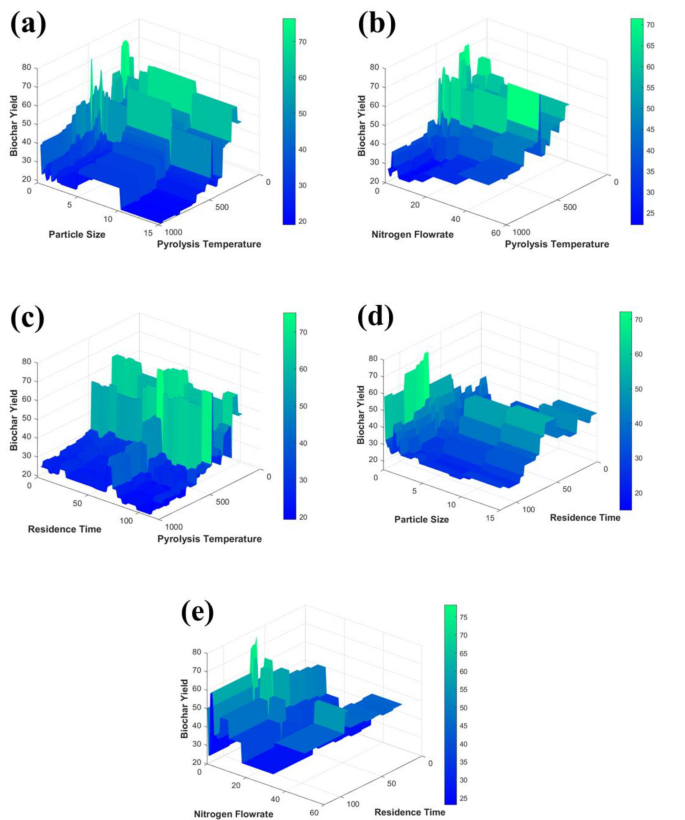
The team used Particle Swarm Optimization (PSO) and Genetic Algorithms (GA) to improve model performance through feature selection and hyperparameter tuning. Sensitivity analysis identified pyrolysis temperature as a major factor influencing biochar yield, alongside volatile matter and heating rate, while Monte Carlo simulations and Sobol sensitivity analysis examined uncertainty and combined parameter effects.
Model & Experimental Highlights
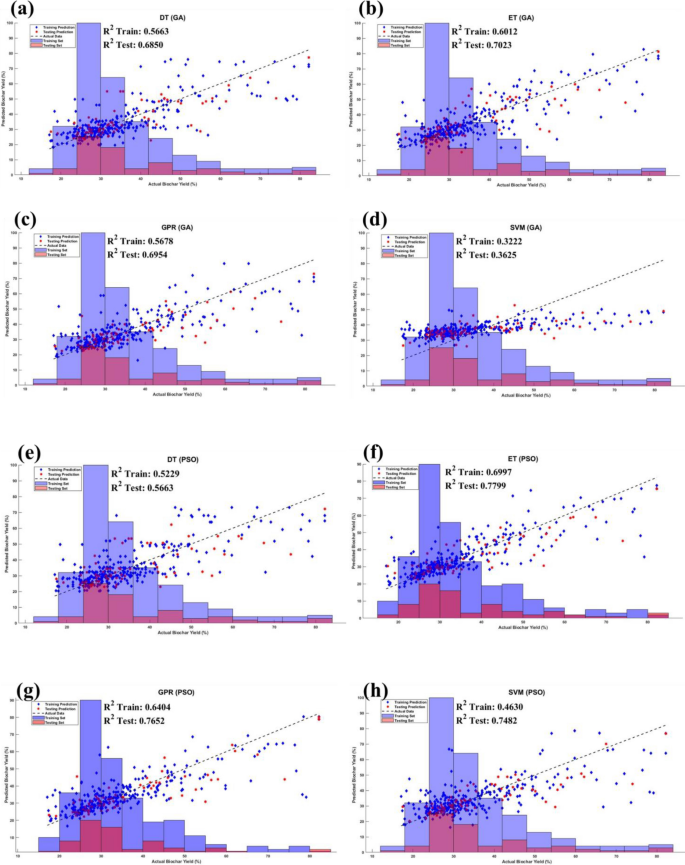
- Top Model Performance: The PSO optimized Ensemble Tree model achieved the strongest predictive results with a testing R² of 0.7799 and a root mean square error of 6.9792.
- Local Biomass Validation: Tested on algal biomass from Rawal Dam, Simli Dam and Shahpur Dam in Pakistan, with laboratory pyrolysis errors below 6%.
- High Yield Optimization: Inverse optimization predicted a 76.33% yield at 500 °C, 10 °C/min, 60 minutes, 0.5 L/min nitrogen flow and 1.5 mm particle size, achieving 75.42% in lab testing (1.12% error).
The researchers also developed a graphical user interface that allows users to enter biomass composition and processing conditions to obtain biochar yield predictions using the optimized model. By integrating machine learning, optimization algorithms, sensitivity analysis and laboratory validation, this research offers a data driven approach to guiding experimental planning and supporting sustainable biomass conversion technologies.
Read the Paper
“Machine learning optimization for algal biochar yield: integrating experimental validation and sensitivity analysis,” Biochar, 2026.
About the Author
Jawad Gul
PhD Student, Alternative Fuels and Sustainability Laboratory
School of Chemical and Materials Engineering (SCME), NUST