
Challenge:
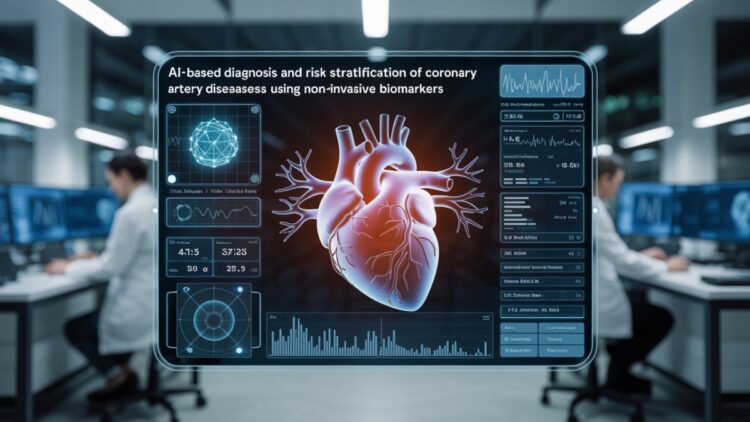
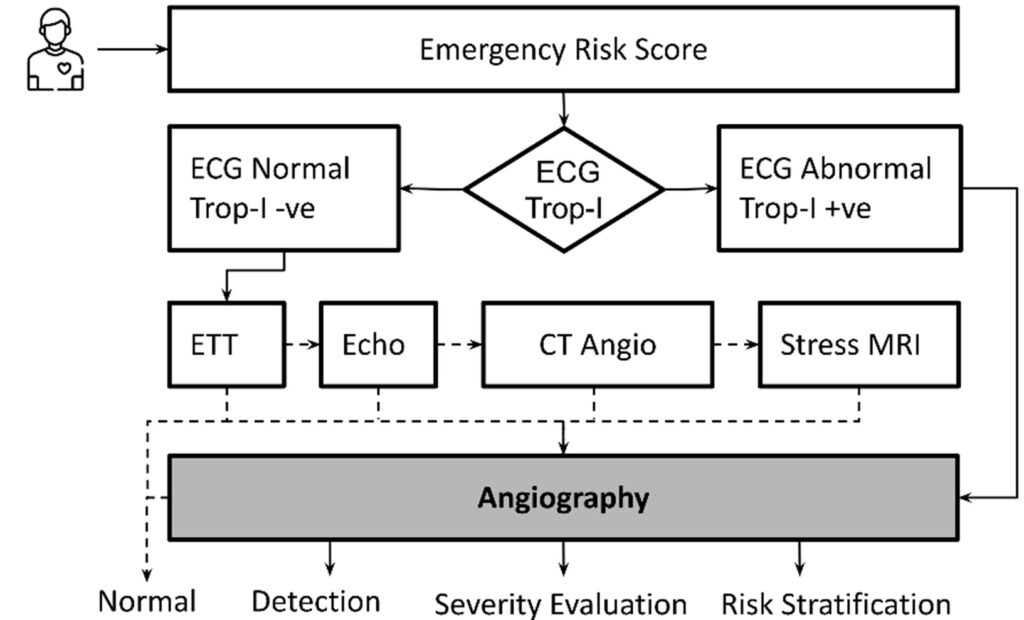
Coronary Artery Disease (CAD) remains a leading global health issue, significantly contributing to mortality and serving as a primary cause of sudden cardiac arrest. Early detection and accurate diagnosis of CAD are crucial for timely intervention, potentially saving lives. Detecting CAD early without coronary angiography, the gold standard for CAD diagnosis, presents significant challenges. Angiography is invasive, costly, and carries certain risks. This study seeks to address this challenge by subclassifying the disease diagnosis by proposing an intermediate step using non-invasive methodological framework, thus preventing the multiple tests required before angiography to diagnose CAD.
Dataset:
At the core of this research is the use of novel clinical, chemical, and molecular cardiac biomarkers used for the first time in an AI-based Coronary Artery Disease (CAD) detection and risk stratification study. These biomarkers, sourced from the carefully curated NUMS-NIHD dataset, serve as essential input features for the model. The dataset is enriched with biomarkers that provide comprehensive insights into cardiac health, offering a broader understanding of CAD compared to conventional diagnostic techniques.
Purpose and Significance of the Research:
The purpose of this research is to develop a novel and innovative approach for the accurate diagnosis and risk stratification of Coronary Artery Disease (CAD) through the integration of non-invasive biomarkers and AI techniques. This study aims not to replace the gold standard of coronary angiography but to serve as an intermediate step in the diagnostic process prior to the decision to proceed with angiography. The research posits that angiography may be avoided if the proposed tests and risk stratification protocols are implemented following emergency protocols. The significance of this study lies in the ability of biomarkers and machine learning (ML) techniques to provide early, accurate, and non-invasive detection and risk assessment of CAD. The framework seeks to predict outcomes typically derived from angiography, offering a safer and more cost-efficient pre-angiography alternative.
Proposed Methodology:
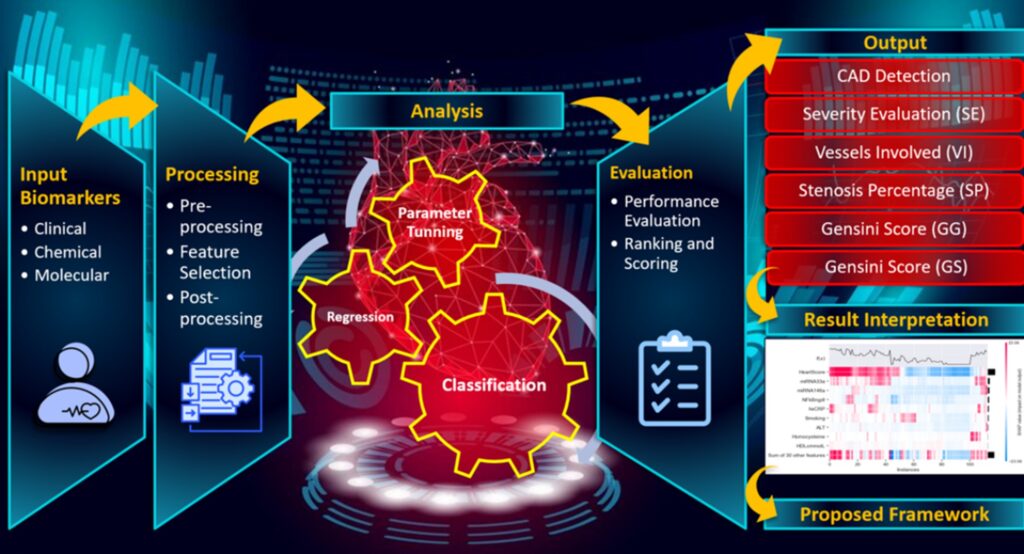
To address six key challenges related to the detection, evaluation of Coronary Artery Disease (CAD) severity, and stratification of CAD risk, a number of classification and regression techniques were employed. Six feature selection techniques and two ranking classifiers were employed to identify the most relevant feature sets, ensuring optimal predictive accuracy. Hyperparameter tuning, combined with 10-fold cross-validation, was performed to optimize model performance. This rigorous approach ensured that the models were well-calibrated and capable of generalizing across different patient datasets. The study utilizes 10-fold cross-validation for both classification and regression tasks, ensuring comprehensive and robust model evaluation. Furthermore, the results are validated using a hold-out dataset to provide an additional assessment of the model’s performance.
Results:
For classification tasks ten ML classifiers were applied. Binary classification for Coronary Artery Disease (CAD) detection achieved an accuracy of 97.18%. The study tackles more complex classification problems, such as predicting the number of cardiac vessels involved (VI), classifying patients into Gensini groups (GG), and CAD severity evaluation (SE) through multi-classification. The accuracy achieved was 82.58% for VI prediction, 86.26% for GG classification, and 90.91% for SE evaluation. Beyond classification, the study also explores regression analysis to estimate two crucial clinical measures: the Gensini score (GS) and stenosis percentage (SP). These metrics offer detailed information about the extent of coronary artery blockages. Using ten regression models, the study achieved R-squared values of 0.58 for the GS and 0.56 for SP.
Clinical Utility:
The proposed framework integrates clinical protocols with advanced ML techniques, offering a reliable, non-invasive, and cost-effective alternative to traditional methods. By leveraging the most informative biomarkers alongside optimal ML classifiers and regression models, the research highlights the potential of “biomarker-ML combination” approach. The study offers an innovative and cost-effective solution for CAD diagnosis, presenting a non-invasive, highly accurate method that can be applied prior to coronary angiography. By integrating biomarkers with ML into a unified framework, this research represents a significant advancement in the early detection and risk stratification of CAD, with the potential to reduce mortality rates.
The proposed approach is designed for easy implementation and seamless integration into clinical settings, with a focus on direct measurement of biomarkers. Methodology is much less computation-intensive, requiring a few seconds to provide a result, though computation time is not a major factor. By collaborating with cardiologists, the study ensures that its methodology aligns with established healthcare workflows, enabling smooth adoption without disrupting standard clinical practice. By prioritizing clinical applicability, this method offers a reliable and accessible alternative to conventional diagnostic techniques, improving early detection and intervention while optimizing healthcare resources by reducing the reliance on invasive procedures such as coronary angiography. This framework promotes a patient-centred model of care by improving accessibility, safety, and efficiency, thereby facilitating timely CAD management and contributing to improved long-term health outcomes.
References:
- Sajid M et al. (2024) “AI-CADR: Artificial Intelligence Based Risk Stratification of Coronary Artery Disease using Novel Non-invasive Biomarkers”, IEEE Journal of Biomedical and Health Informatics (IEEE J-BHI), Volume 28, Issue 12, December 2024. DOI: 10.1109/JBHI.2024.3453911
- Sajid M et al. (2025). “AI-CADS: An Artificial Intelligence Based Framework for Automatic Early Detection and Severity Evaluation of Coronary Artery Disease”, Elsevier Biomedical Signal Processing and Control (BPSC), Volume 106, August 2025, 107705. DOI: 10.1016/j.bspc.2025.107705.
- Sajid M et al. (2024).”AI-Based Early Detection of Coronary Artery Disease Using Atherosclerosis Inflammatory and MicroRNA Biomarkers in Angina Patients,” 2024 International Conference on Robotics and Automation in Industry (ICRAI), Rawalpindi, Pakistan, 2024, pp. 1-7. DOI: 10.1109/ICRAI62391.2024.10894670.
The author was a PhD Scholar, worked under the supervision of Dr. Ali Hassan at College of Electrical and Mechanical Engineering (CEME), National University of Sciences and Technology (NUST). He can be reached at [email protected].