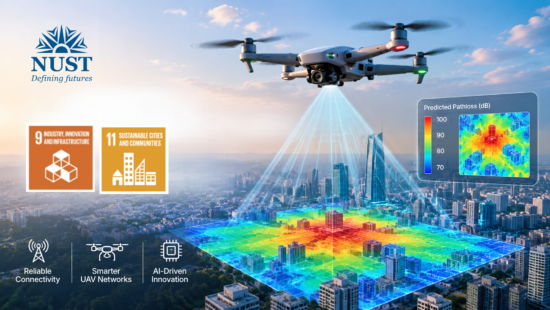
Enhancing UAV Networks Through Multi-Scale U-Net Deep Learning Framework

Research NUST researcher develops a multi scale U-Net deep learning framework that cuts urban millimeter wave signal pathloss prediction error to 3.15 dB for reliable UAV network planning. As unmanned aerial vehicles (UAVs) become increasingly important to next-generation wireless networks, ensuring reliable communication in complex urban environments remains a significant challenge. Buildings, signal obstructions and…

Loading

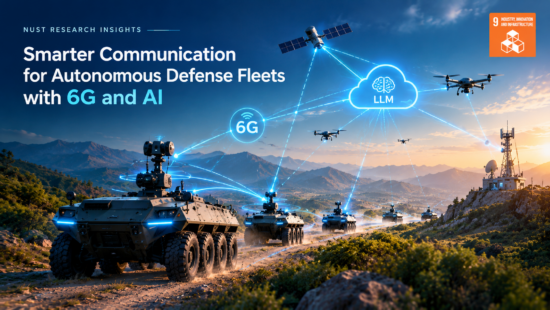
Smarter Communication for Autonomous Defense Fleets with 6G and AI

The 6G–LLM system kept 82.9% of missions successful versus 14.2% for 5G, while cutting latency by 75%. Imagine a convoy of self-driving vehicles moving through contested terrain, where every second of delay matters. Researchers at NUST combined next-generation 6G networks with Large Language Models (LLMs) to help fleets of autonomous defense vehicles share what matters…

Loading

Hybrid Control Paradigm for Immersive VR Teleoperation

The rapid advancement of immersive virtual reality (VR) technologies has opened unprecedented possibilities for enhancing remote collaboration and teleoperation tasks, enabling users to experience realistic telepresence in distant or hazardous environments. However, achieving effective and intuitive control in VR-based telepresence systems remains challenging, often hindered by factors such as latency, limited situational awareness, and inadequate…

Loading

Exploring Deep-Sea Discoveries with AquaBot

Remotely Operated Vehicles ROVs have gained increased recognition for their accessibility and practicality in executing underwater tasks that would be challenging for human divers. Their compact design allows them to reach significant depths, proving valuable across various fields from scientific to industrial. In the present era, ROVs find application in multiple domains, including exploring the…

Loading