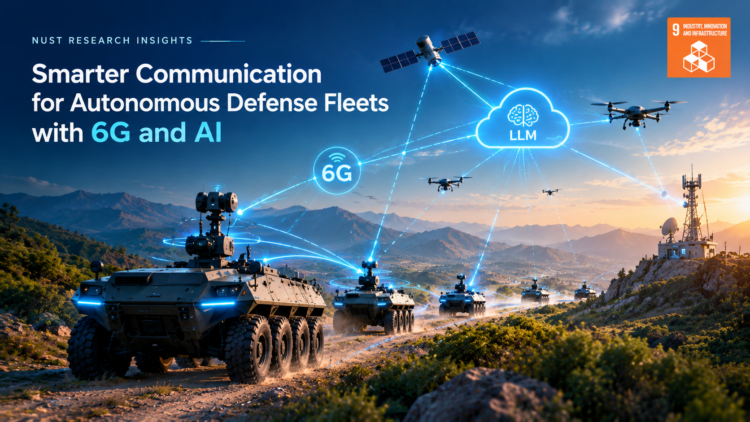
The 6G–LLM system kept 82.9% of missions successful versus 14.2% for 5G, while cutting latency by 75%.

Imagine a convoy of self-driving vehicles moving through contested terrain, where every second of delay matters. Researchers at NUST combined next-generation 6G networks with Large Language Models (LLMs) to help fleets of autonomous defense vehicles share what matters and only what matters.
Why Fleet Coordination Needs Innovation
Autonomous defense vehicles can reduce risk to soldiers and support logistics and reconnaissance. But each vehicle produces several megabytes of LiDAR, radar, and camera data every second. As fleets grow, sending all of it clogs the network, and relying on distant cloud servers adds delay. Under jamming, decisions arrive late and coordination breaks down.
A New Idea: Send Meaning, Not Data
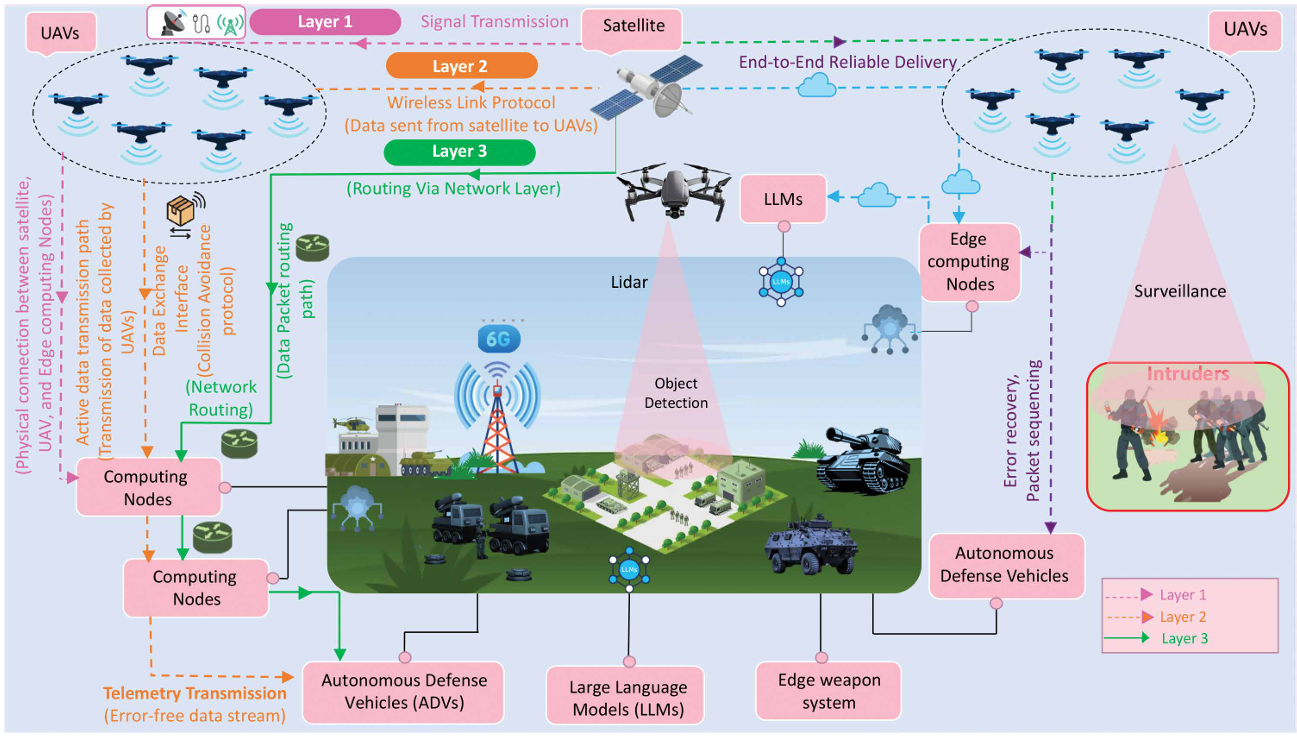
The researchers proposed a three-layer architecture, with vehicles at the edge, command units nearby, and a cloud control center for planning. Instead of streaming raw sensor feeds, each vehicle sends a short structured message of under 512 bytes. It states what was detected, how confident the system is, where it is, and what action is recommended.
A compact LLM running on a nearby edge server creates these messages, acting as a smart compressor rather than a chatbot. The fixed format limits the risk of hallucinated content, and neighboring vehicles cross-check each other before acting.
Putting It to the Test
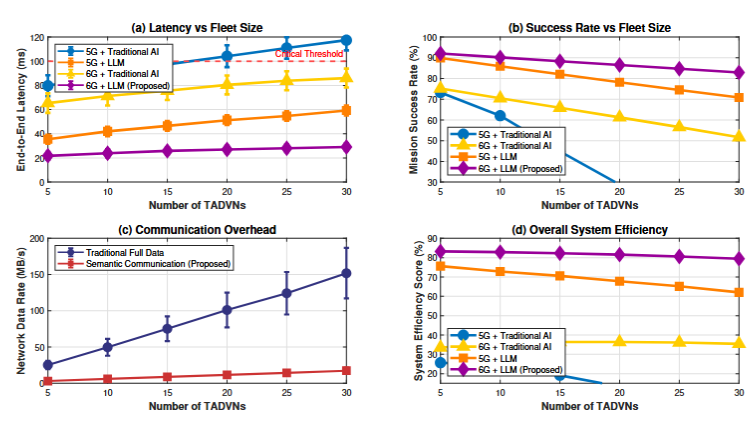
The team ran 500 simulations per setup, with fleets of 5 to 30 vehicles under interference and jamming. They compared the proposed system against 5G and conventional AI, among other setups. At 30 vehicles, the 6G–LLM system showed:
- Latency: 29.1 ms versus 117.5 ms, a 75.2% reduction.
- Mission success: 82.9% versus 14.2%.
- Network load: 17.3 MB/s versus 151.9 MB/s, an 88.6% reduction.
Neither 6G nor an LLM alone delivered these gains. It took both together.
Why This Matters
Sending less data also makes vehicles harder to detect and more resilient to jamming. It frees up spectrum for urgent messages and may extend battery life, though that estimate still needs hardware validation.
A Look Ahead
The results come from simulation under idealized 6G targets, so they show trends rather than guaranteed field performance. The team plans hardware-in-the-loop testing as 6G matures. They also plan to study adversarially robust semantic communication and privacy-preserving federated learning.
Read the Paper
Explore the complete study published in IEEE Network (2026).

About the Author
Dr. Kiran Khurshid
Assistant Professor | College of Electrical & Mechanical Engineering (CEME), NUST
Profiles: Faculty Page | Google Scholar