
For millions of people across Pakistan, herbal medicines are not just supplements — they are trusted remedies, passed down through generations and relied upon daily for healing. From roadside dispensaries to household kitchen shelves, plant-based treatments remain the first line of care for countless communities where modern healthcare is distant. But behind this deep cultural reliance lies a hidden risk: the quality and safety of these herbal products are rarely tested, and unlike pharmaceuticals, they face no strict regulatory checks.
Alkaloids — powerful plant compounds — Yet detecting them has long required sophisticated analytical laboratory instruments, technology that is far too expensive and inaccessible for small testing labs, traditional medicine practitioners, or rural researchers. As a result, vital quality screening becomes slow, costly, or simply never done — putting both trust and public health at silent risk.
The Vision
This research began with a simple but powerful mission: to make alkaloid testing as accessible as the herbal medicines it seeks to protect. Instead of relying on costly analytical machines locked within specialized laboratories, our goal was to create a low-cost, tablet-based system that could detect alkaloids rapidly and visually — right in the hands of small local labs, field researchers, or regulatory officers. The idea was clear: transform classical color-based alkaloid reactions into stable, field-ready “test tablets” that work instantly — no electricity, no complex expertise, just a trustworthy result within minutes.
How It Works
The system is built around a simple idea — bring lab-grade alkaloid detection into a portable tablet format that anyone can operate in the field. Each tablet is dry-pressed using optimized pharmaceutical formulation techniques and instantly transforms into a functional reagent when dropped into water.
Three tablet types were developed, each corresponding to a classical alkaloid indicator:
- Reagent A (picric acid–based),
- Reagent B (iodine–potassium iodide complex), and
- Reagent C ( a mercuric chloride and potassium iodide formulation).
Once dissolved, these solutions are ready for immediate testing — no electricity, no instrumentation, no technical expertise required.
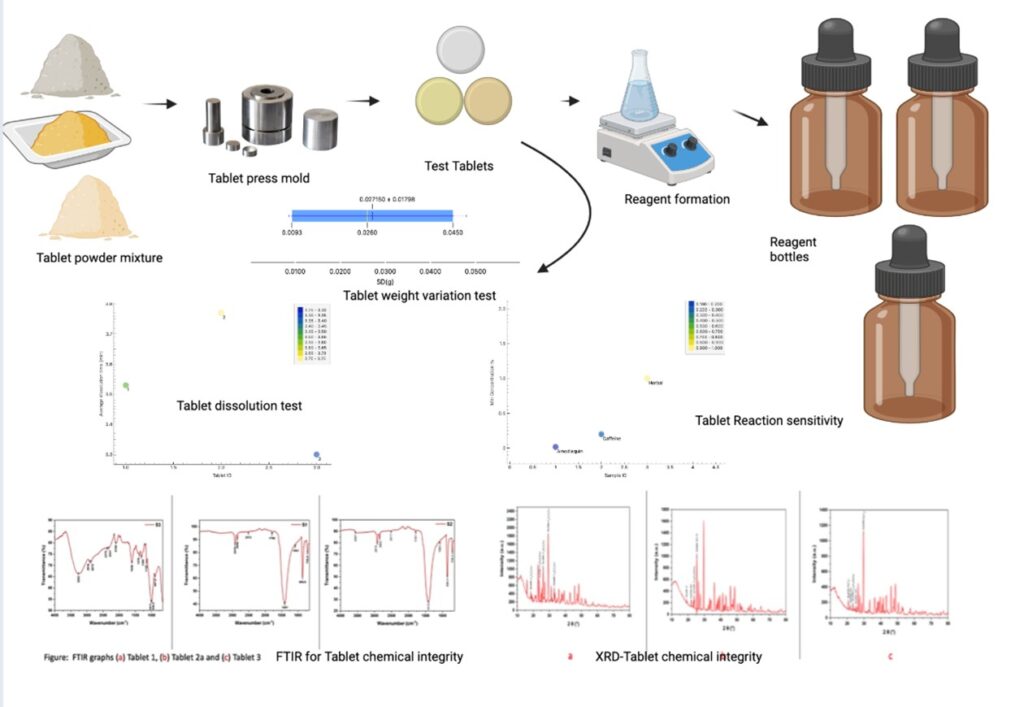
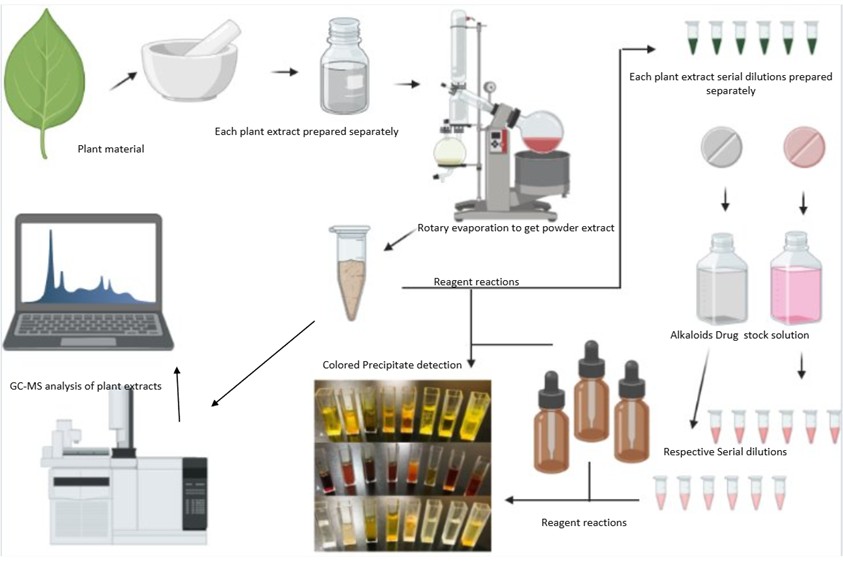
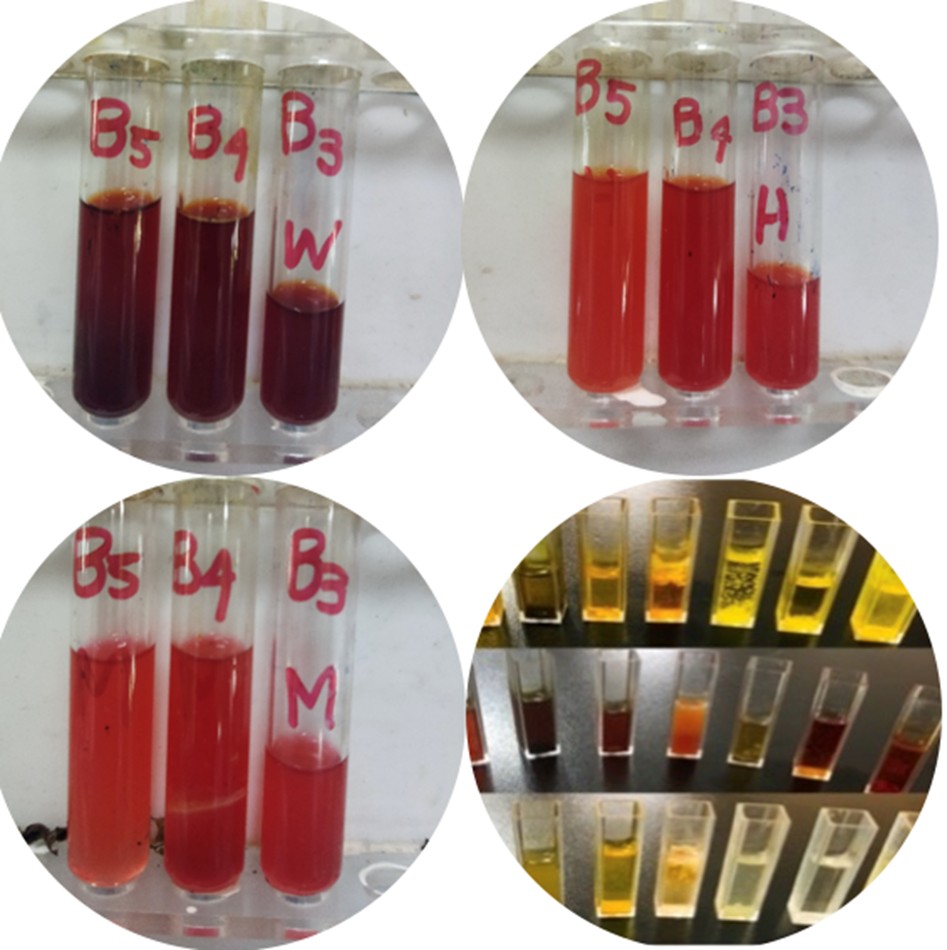
To validate real-world usability, extracts from commonly used Pakistani medicinal plants — including lemongrass, stevia, peppermint, turmeric, and sea-buckthorn — were tested alongside pharmaceutical-grade alkaloid standards. The reaction is fully visual: yellow, brown, or creamy white development signals a positive alkaloid presence, while a blank sample (distilled water) remains unchanged — eliminating ambiguity.
To prove scientific accuracy, the same extracts were cross-verified using GC–MS, the gold-standard lab instrument for alkaloid profiling. The results aligned perfectly — confirming that the tablet-based method is not just accessible, but also analytically credible and industry-ready.
Novelty — What Makes This Invention Different?
This first-of-its-kind tablet in Pakistan combines chemistry, practicality, and scientific rigor:
- Fast results: Dissolves in 3–4 minutes with a visible color change and precipitate if alkaloids are present.
- Reliable & stable: Validated shelf life of 14 months.
- Scientifically verified: Cross-checked with GC–MS for research-grade credibility.
- Integrated innovation: Merges classical phytochemistry, pharmaceutical tablet tech, and modern validation into a practical tool for labs, educators, and regulators.
This breakthrough makes alkaloid testing faster and easier.
Why It Matters
The development of ready-to-use alkaloid test tablets represents more than just a scientific achievement—it addresses pressing practical needs across multiple sectors:
- For regulators & inspectors: These tablets enable on-site verification of herbal products, eliminating the need to send samples to distant laboratories and endure long waiting periods.
- For academia & teaching labs: They provide a cost-effective, hands-on tool for demonstrating alkaloid chemistry and quality control, making learning more interactive and accessible.
By bridging the gap between laboratory analysis and real-world application, these tablets make alkaloid detection faster, simpler, and more reliable.
Impact for Pakistan
This innovation has the potential to transform herbal quality assurance in Pakistan:
- Affordable testing: The tablets reduce the dependency on expensive laboratory infrastructure, making routine quality checks financially feasible for regulators and local producers.
- Educational advancement: Universities and teaching labs can integrate these tablets into practical lessons, enhancing experiential learning for students in pharmacognosy, chemistry, and biosciences.
- Regulatory efficiency: With rapid, on-site detection, regulatory agencies can act swiftly to ensure safety and compliance in the herbal products industry.
Future Development and Roadmap
The research is evolving into exciting new phases:
Compound-specific detection: working on protocol in specific compounds detection and quantification in a single test, further improving precision and efficiency.
- Commercialization pathways: Efforts are underway to bring this technology to the market, benefiting NUST, regulators, and the broader herbal industry.
- Expanded Educational applications: Future iterations may include integrated kits for hands-on teaching of phytochemistry and quality control, supporting both academic and vocational training.
These developments promise to make alkaloid testing even more user-friendly, cost-effective, and impactful, while ensuring that students, regulators, and producers can all benefit.
Conclusion
The ready-to-use alkaloid test tablets are more than a scientific innovation—they are a step toward faster, safer, and more accessible quality assurance in Pakistan’s herbal industry.
By combining simplicity, affordability, and educational value, this initiative empowers regulators, enhances learning, and opens doors for commercial adoption. With support from academia, industry, and policymakers, these tablets could redefine how Pakistan ensures the safety, reliability, and quality of its herbal products.
NUST Team Contribution
This project was carried out at Atta-ur-Rahman School of Applied Biosciences (ASAB), National University of Sciences and Technology (NUST).
Principal Investigator (PI): Dr. Mohammad Qasim Hayat
Lead Researcher: Atteqa Safdar (PhD Researcher)
Research Group: Department of Agricultural Sciences and Technology, ASAB–NUST
NUST’s contribution lies in transforming a classical lab procedure into a deployable, industrially relevant screening tool — bridging research with real-world impact, aligned with national industrial and regulatory needs.
References:
1. Safdar, A., Iftikhar, S., Karim, M. et al. (2025). Rapid and cost-effective colorimetric detection of alkaloids in botanical extracts using a novel protocol with compressed tablets. Scientific Reports 15, 26332. doi: 10.1038/s41598-025-11907-w
2. BioRender (2025). Created using BioRender.com. Available at: https://BioRender.com.
The author is a PhD Student at Atta ur Rahman School of Applied Bio Sciences, National University of Sciences and Technology (NUST). She can be reached at [email protected].