

Pakistan ranks among the most vulnerable nations globally to the adverse impacts of climate change, facing an escalating crisis marked by extreme weather events and shifting hydrometeorological patterns. Despite this alarming reality, the country remains critically deficient in the infrastructure and resources necessary to establish a robust climate change monitoring system. The absence of an integrated and well-equipped observational network significantly hampers the ability to predict and respond to emerging climatic shifts, particularly in hydrometeorological parameters such as precipitation patterns, temperature variations, and atmospheric moisture levels. Consequently, forecasting future hydrometeorological trends becomes exceedingly challenging, leaving policymakers and stakeholders with limited capacity to implement effective mitigation and adaptation strategies.
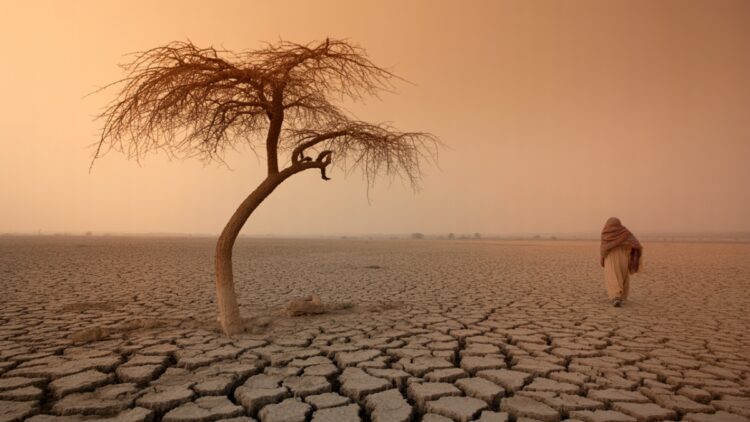
One of the most pressing concerns in this regard is the increasing frequency and severity of extreme weather events, particularly droughts. The lack of comprehensive real-time monitoring not only impedes early warning systems but also exacerbates the socio-economic ramifications of prolonged dry spells, leading to reduced agricultural yields, water scarcity, and heightened food insecurity. In a country where a significant portion of the economy depends on water-intensive sectors, these climatic uncertainties pose a severe threat to sustainable development and long-term resilience. Addressing this crisis requires an urgent and strategic investment in climate observation networks, hydrometeorological research, and data-driven policymaking to mitigate the growing risks associated with Pakistan’s changing climate.
This project primarily focused on climate change monitoring through decadal variations in drought indices and identification of localized drought hotspots to build bases for proactive approaches for drought mitigation accuracy assessment. With its workflow, it also involved the accuracy assessment of a model-based meteorological data source (ERA5-Land) as a potential solution to sparsity of weather/climate observatories network in Pakistan.
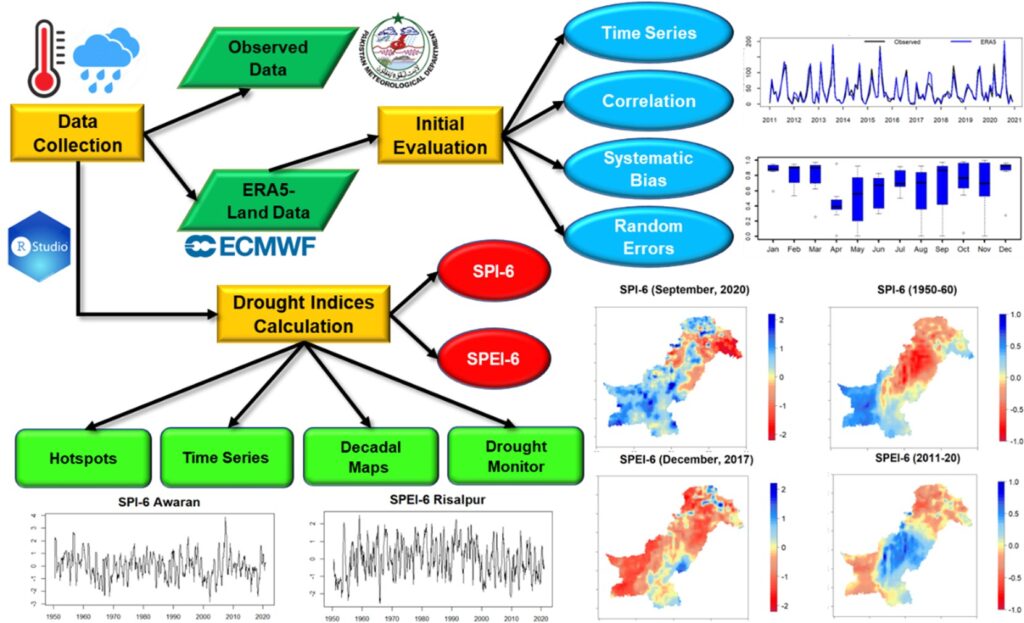
ERA5-Land showed promising accuracy in following the fluctuation patterns of monthly observed precipitation and temperature. Statistically, it displayed low bias; acceptable values of correlation coefficient and RMSE for both temperature and precipitation. Monthly observed anomaly time series of precipitation and temperature are well-matched by ERA5-Land, indicating the potential of ERA5-Land to be used in drought monitoring studies. Historical decadal spatial plots for 6-monthly SPI and SPEI depict some obviously expected hotspots over Balochistan while there are scattered drought trends over North-Western regions of Pakistan as well, indicating the decrease in precipitation and increase in temperature in those regions. This finding confirms one of the conclusions extracted by a syndicate working on climate profiling of Pakistan last year. Timeseries plots for SPI and SPEI over some of the hotspots indicate an overall increasing susceptibility of Awaran, Multan, Thatta, and Risalpur to meteorological droughts.
Investigation of time series and statistical accuracy of ERA5-Land has resulted in an established level of reliability that could benefit the research and drought mitigation works over mountainous and hard-to-access areas where observation network is sparse. Based on its technical analyses, the project recommends a proactive approach to be adopted instead of the reactive approach to mitigate the effects of droughts in Pakistan. Pakistan drought monitor (an interface to be developed by automation of R-coding applied in the project) is recommended to be used by public institutions such as NDMA, PMD, and NDMC to keep an archive of previous drought trends and maps for research purposes as well as for decision making purpose by the concerned stakeholders.
The author is Assistant Professor at Military College of Engineering, National University of Sciences and Technology (NUST). He can be reached at [email protected].
Research Profile: https://bit.ly/468MPWc