
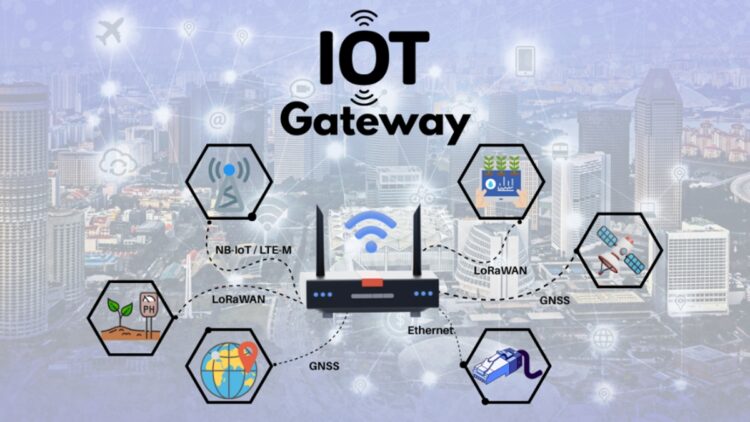



Adaptive IoT Gateway is an indigenous communication platform developed in Pakistan to overcome the limitations of traditional gateway solutions, which are often costly to deploy, difficult to adapt across diverse environments, and prone to inconsistent performance. These challenges become particularly critical in large-scale deployments such as smart cities, agriculture, and remote monitoring, where stable connectivity, efficient switching, and data security are essential.
Engineered to support Wi-Fi, LTE-M/NB-IoT, and LoRa technologies within a single unified system, the gateway features an AI-driven adaptive switching mechanism. This mechanism continuously monitors real-time parameters such as signal strength, traffic load, environmental conditions, and channel performance to dynamically select the most suitable communication path. Built on ARM Cortex-M microcontrollers with ARM-compliant APIs, the device ensures high efficiency, security, and compatibility with current Industry 4.0 standards, while also being adaptable for Industry 5.0 innovations like human-centric automation and intelligent edge processing.
By leveraging edge AI, the gateway enables uninterrupted, low-latency communication and learns from historical trends to anticipate network performance and optimize connectivity in real time. This proactive approach enhances energy efficiency and ensures reliability even in fluctuating environments.
Through this locally developed solution, the project not only aims to strengthen Pakistan’s digital infrastructure but also contributes to import substitution by reducing reliance on foreign gateway technologies. By enabling secure, adaptive, and scalable IoT connectivity, this indigenous system supports the national vision of smart, connected, and self-reliant urban ecosystems.
Integrating Diverse Communication Technologies
The gateway supports multiple connectivity standards, making it versatile across varied field conditions:
- LoRaWAN provides long-range, low-power communication ideal for sectors like agriculture, environment and energy monitoring, and smart infrastructure.
- GNSS module allows precise geo-positioning to support asset tracking and location-based analysis.
- Ethernet acts as the primary wired connection, delivering high-speed, reliable, and low-cost communication where infrastructure is present.
- NB-IoT/LTE-M cellular technologies ensure wide coverage and wireless data transfer in remote or infrastructure-deficient areas.
These technologies collectively enable the gateway to perform reliably across different deployment environments.
Robust Hardware for Real-World Deployment
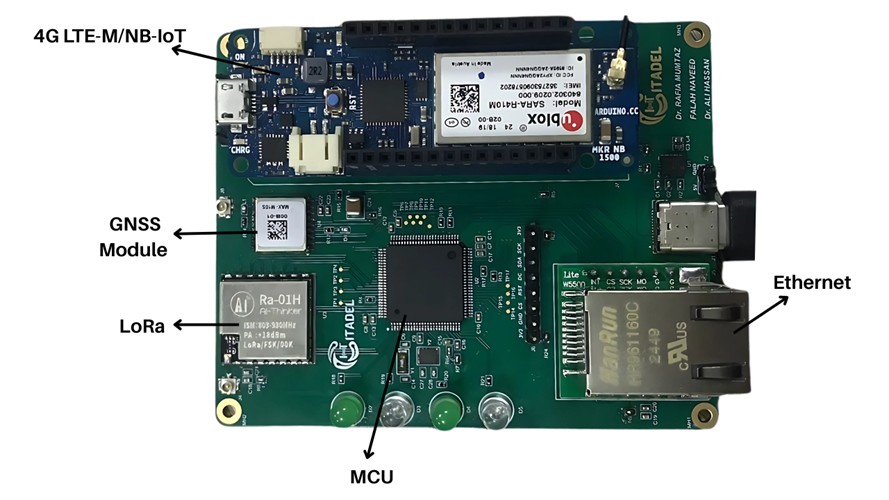
The system’s hardware design has been carefully engineered to support long-term outdoor and industrial deployment. The internal components, including a custom PCB, offer ruggedness, expandability, and seamless integration with external sensors.
The hardware image of the PCB layout [Figure 1] shows the internal circuitry and component arrangement, emphasizing the practical build of the device.
Bridging IoT Networks with Adaptive Switching
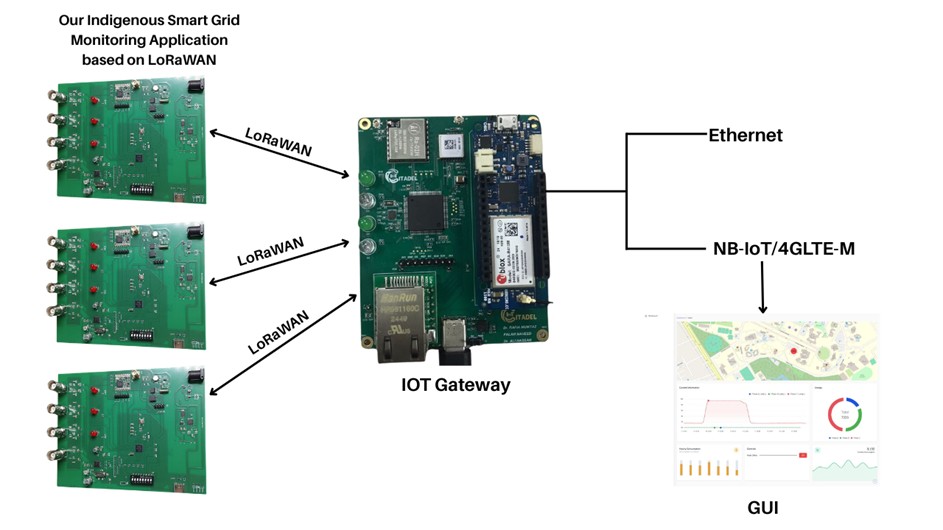
At the core of the system lies an adaptive network logic that continuously monitors real-time parameters such as signal strength, latency, bandwidth, and reliability. Based on these metrics, it dynamically switches between Ethernet and cellular (NB-IoT or LTE-M) communication paths to maintain stable connectivity.
This reliable communication flow is depicted in the system architecture diagram [Figure 2], which illustrates how various modules, LoRa nodes, GNSS, Ethernet, and cellular, interact with the cloud to enable uninterrupted data flow.
Securing Communication with MQTT Protocol
Adaptive IoT Gateway utilizes Secure MQTT (Message Queuing Telemetry Transport) as its core communication protocol. This lightweight, encrypted protocol ensures the security and integrity of transmitted data, protecting against unauthorized access or tampering. This feature is especially vital for applications in sensitive areas such as healthcare, finance, and public infrastructure.
Data encrypted with MQTT enhances user trust and complies with industry-level standards for secure IoT deployments.
User-Friendly Interface for Monitoring and Management
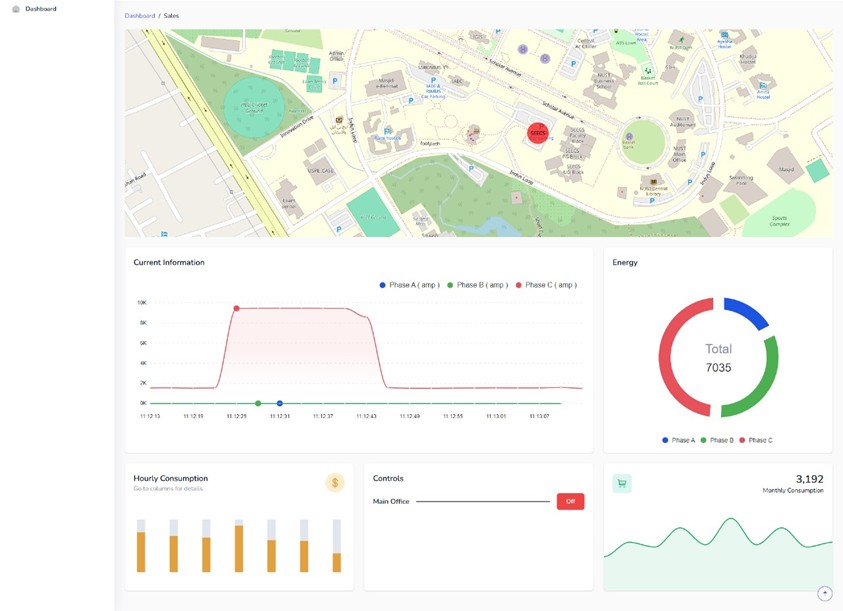
In addition to robust hardware and secure communication, the gateway includes a web-based dashboard that empowers users to manage and monitor connected IoT systems efficiently. The dashboard offers real-time data visualization from LoRa nodes, system health indicators, network switching logs, and performance analytics. An example showing the deployment of the IoT Gateway for an energy monitoring system demonstrates how logs of different nodes and switches are connected and tracked.
The dashboard interface [Figure 3] is designed with simplicity in mind, ensuring even non-technical users can operate and monitor their systems with ease.
Versatile Applications and Benefits
The Adaptive IoT Gateway is designed to serve multiple domains, including:
- Agriculture: Real-time monitoring of crop conditions, soil health, and weather patterns to support decision-making and improve yield.
- Environmental Monitoring: Continuous data collection on air and water quality, enabling proactive measures and rapid response.
- Smart Cities and Infrastructure: Reliable data communication for systems like energy management, traffic control, and public safety.
Adaptive IoT Gateway delivers consistent connectivity and optimized performance by intelligently managing communication paths in real time. Its support for scalable deployments using multiple LoRa nodes, along with end-to-end encrypted communication, makes it a secure and future-ready solution.
This gateway represents a major advancement in IoT infrastructure, addressing key challenges such as inconsistent connectivity, security, and system manageability. By combining adaptive switching, multi-protocol integration, secure MQTT communication, and an intuitive monitoring interface, it delivers a comprehensive solution for modern IoT deployments.
With its flexible architecture, rugged hardware, and user-friendly dashboard, the Adaptive IoT Gateway enables industries to build resilient, efficient, and secure IoT ecosystems, paving the way for smarter, data-driven operations across diverse sectors.
The co-authors include Mr. Falah Naveed, a research assistant at Pak Thai Digital Innovation Lab, SEECS ([email protected])
The author is a Tenured Professor and Associate Dean at the School of Electrical Engineering and Computer Science (SEECS), National University of Sciences and Technology (NUST), Islamabad, Pakistan. She can be reached at [email protected].
Research Profile: https://bit.ly/3VSfmIO