

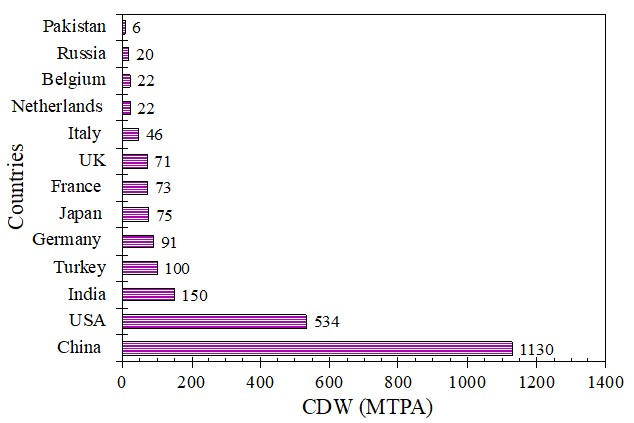
The construction industry has a large environmental footprint due to its heavy use of natural materials and the pollution caused by construction and manufacturing activities. When old buildings are torn down, a huge amount of waste is produced—known as construction and demolition waste (CDW). This type of waste makes up over one-third of all the waste produced worldwide. For instance, the United States produces about 534 million tons of CDW every year, while China generates around 1,130 million tons, which is 30–40% of its total waste. Figure 1 shows how much CDW is generated in different densely populated countries. In developing nations, disasters like floods and earthquakes add even more to the problem, unlike developed countries where demolition and renovation are the main sources. Pakistan, for example, has lost 3.19 million homes to earthquakes and 1.88 million to floods in the past 20 years. Recent disasters in Syria and Turkiye also destroyed tens of thousands of buildings. According to the World Bank, CDW could reach 2.59 billion tons by 2030 and 3.40 billion tons by 2050.
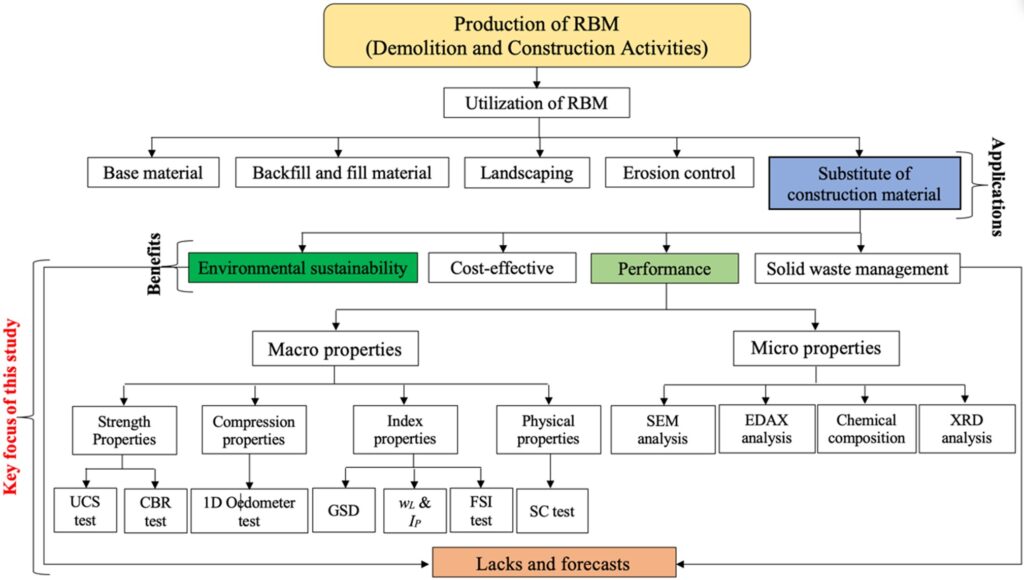
Brick masonry has been a common building material for centuries and is still widely used, especially in developing countries. As old brick structures are demolished, the waste they generate keeps increasing. In fact, brick masonry accounts for about 31% of CDW, which is more than even concrete waste. Recycling this brick waste for new construction offers an environmentally friendly solution. This research focused on using crushed brick powder, mixed with a small amount of cement, to improve the quality of clayey soil. Clayey soil is often seen as problematic for construction due to its weak properties. The brick powder (BP), which contains silicon dioxide (SiO₂), reacts well when combined with cement, which contains calcium oxide (CaO). Together, they trigger chemical changes that improve the soil’s strength. Figure 2 illustrates the overall scope of the study.
The clayey soil used in this study was collected from Chokara in Karak City, Pakistan. This region, part of the Indus River plain, has clay deposits that vary from low to high stickiness (plasticity). Two materials—brick powder and cement—were added to this soil to improve its physical strength. The brick powder was made by crushing old bricks into small particles that could pass through a 4.75 mm sieve. Although finer brick powder helps strengthen cement mixtures, a slightly coarser type was used here to better match the soil’s silt and clay content and make the soil structure more stable and dense. The full methodology and steps used to prepare the soil samples are shown in Figure 3.
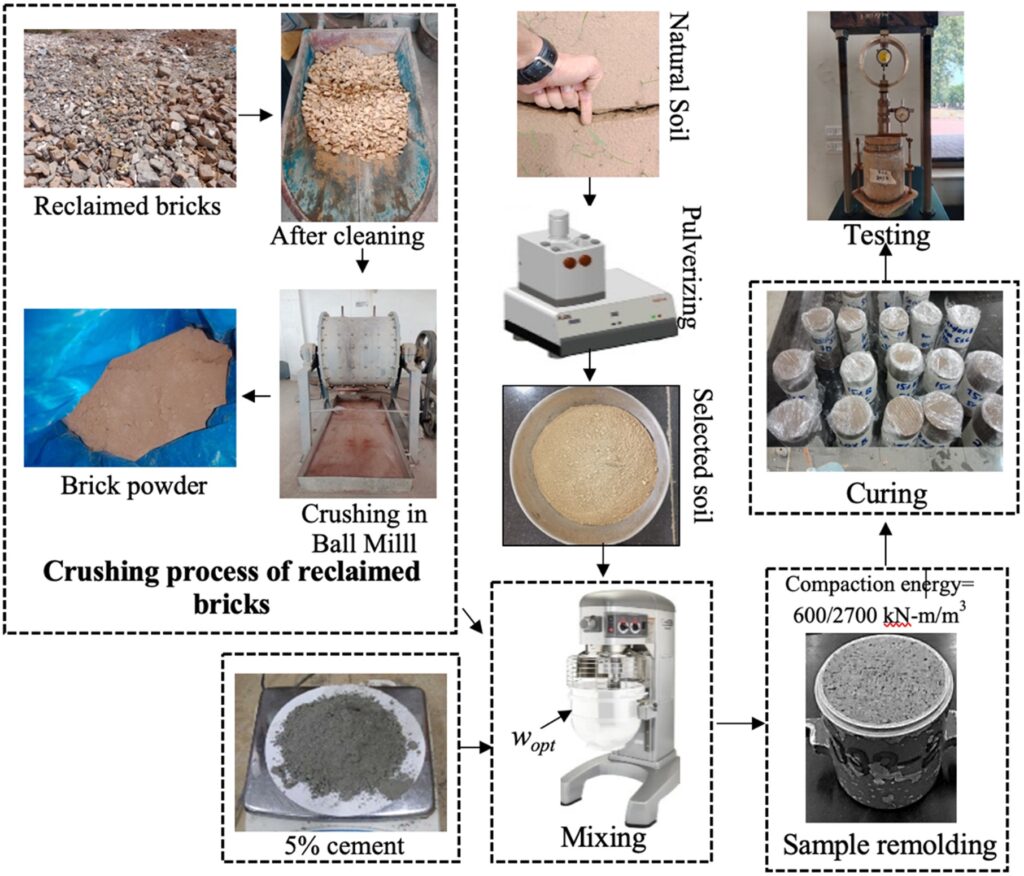
Figure 4 highlights how different amounts of brick powder and cement affected the unconfined compressive strength (qu) of the soil. When used alone, brick powder had very little effect on strength, as it didn’t chemically react with the clayey soil. However, 5% cement significantly increased the soil’s strength. The strength of samples treated with 5% and 10% brick powder was about 200% lower than those treated with 5% cement alone, because cement causes stronger chemical reactions that form binding compounds (CSH and CAH), which brick powder alone does not.
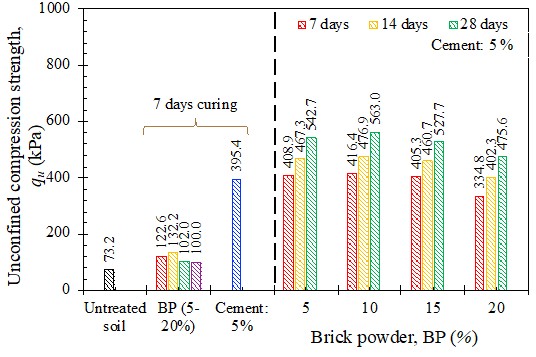
When brick powder was used together with 5% cement, the strength of the soil improved as more brick powder was added—up to a certain point. Beyond 10% brick powder, the strength started to decrease. This is because higher amounts of brick powder made the soil more porous due to the extra sand and silt particles it added. Also, since the amount of cement remained the same in all samples, it couldn’t react with all the extra brick powder effectively. Overall, the combination of brick powder and cement produced much stronger soil than brick powder alone.
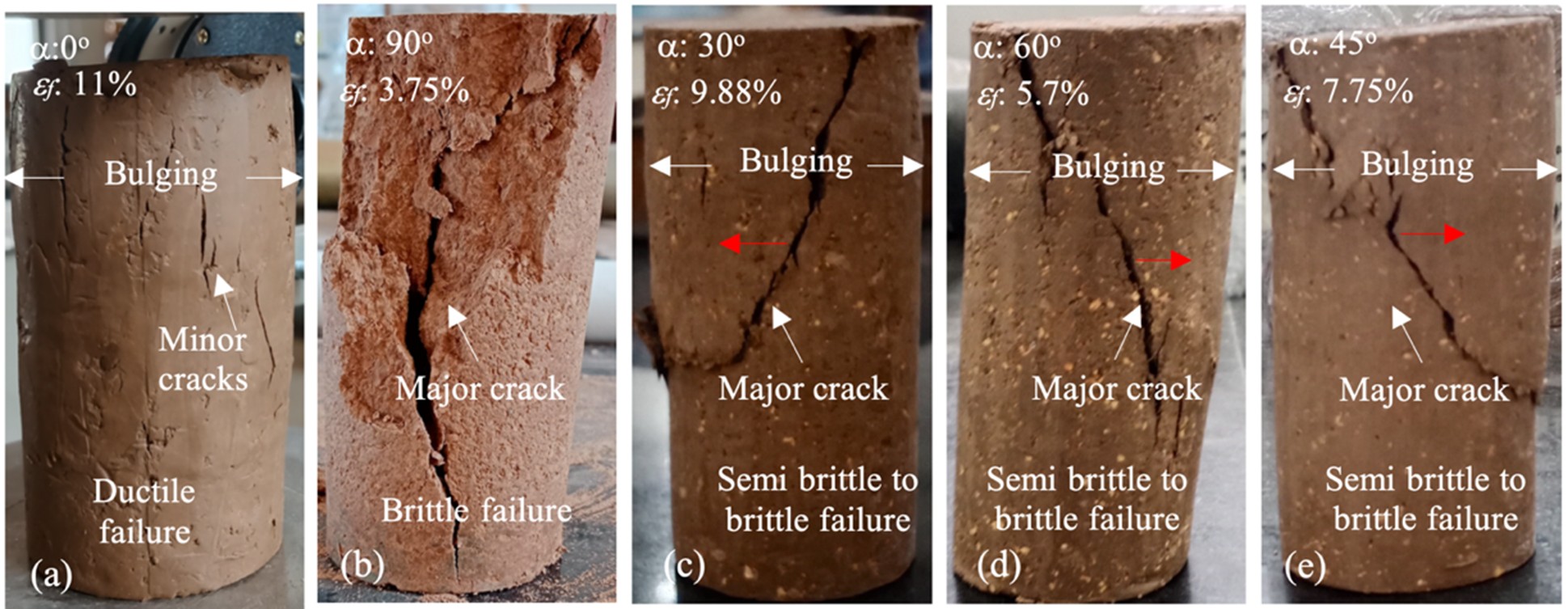
Figure 5 shows how different soil samples broke during the strength test. The untreated sample showed soft, ductile behavior and swelled in the middle, indicating it failed gently. It had no shear angle and broke only after stretching a lot (11% strain). In contrast, the sample with 5% cement broke with a straight vertical crack and had a shear angle of 90°, breaking quickly after stretching just 3.75%. This brittle break showed that the cement had formed solid binding compounds. The samples with only brick powder showed slanted cracks and had different angles and strain levels, breaking in a way that was somewhere between brittle and ductile.
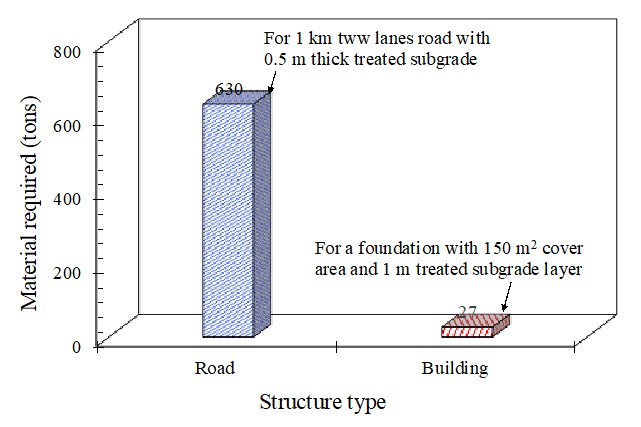
To see how this method could work in real-life projects, the study estimated how much brick waste would be needed for two construction scenarios. For a 1 km two-lane road with a treated subgrade that is 0.5 m thick and 7 m wide, around 630 tons of brick powder would be needed. For a building foundation covering 150 square meters with a treated layer 1 m thick, only 27 tons would be required (see Figure 6). These amounts show that there’s plenty of brick waste available to make this method practical. This approach not only helps reduce the amount of CDW going into landfills but also cuts down the need for cement, making it a greener, more sustainable solution for soil improvement and construction.
Acknowledgement
This project was completed in collaboration with Dr. Zia Ur Rehman from University of Derby, UK.
Reference
Shafqat K, Khalid U, Rehman Z (2025). Coupling effect of cyclic wet-dry environment and compaction state on desiccation cracking and mechanical behavior of low and high plastic clays. Bulletin of Engineering Geology and the Environment, 84: 66. https://doi.org/10.1007/s10064-024-04049-2
The author is Assistant Professor and Head of Geotechnical Engineering Department at the National Institute of Transportation (NIT), Risalpur, National University of Sciences and Technology (NUST). He can be research at [email protected].
Research Profile: https://bit.ly/4lc5Fk5