


For most children in Pakistan, learning Urdu begins with brightly colored books, cheerful classroom activities, and interactive games. But for children who are blind or visually impaired, that joyful learning experience is often out of reach. In Pakistan, more than two million people live with visual impairment, and a large proportion are children. Literacy for them depends almost entirely on access to braille resources, which are scarce, expensive, and often outdated. This creates a double barrier: students not only struggle to access written Urdu but also miss out on the joy of interactive learning that sighted children often take for granted.
To bridge this gap, we introduce the concept of a Gamification-based Advanced Urdu Language Tutor for Visually Impaired learners, a blend of audio-assisted mobile technology, tactile braille hardware, and playful gamification strategies. The idea is simple yet powerful: make learning Urdu accessible, engaging, and fun for children who rely on braille.
The Vision
The “Chasham (چشم)” our proposed Advanced Urdu Language Tutor aims to combine tactile braille displays, mobile applications, and gamified learning to make literacy engaging. Instead of monotonous repetition, students interact with lessons through games, challenges, and rewards.
For example:
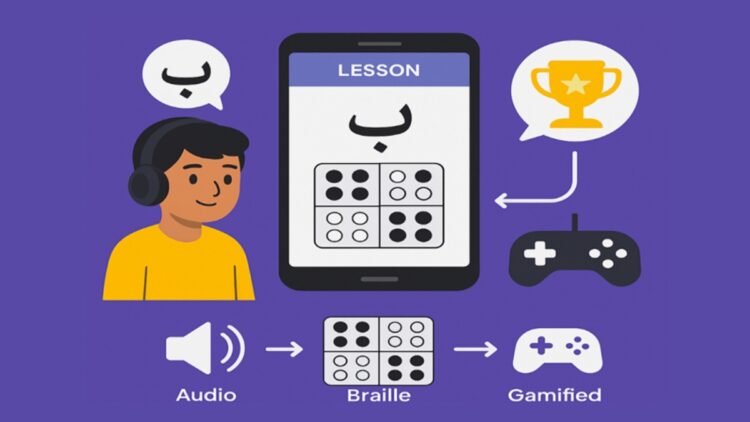
- When learning the letter “ب” (Bay), the app pronounces it, the braille cell raises the correct dots, and the student confirms recognition by pressing a tactile button. If correct, the app plays a celebratory sound and awards points.
- As students’ progress, they unlock levels and stories, where braille letters form words, and words become sentences.
This approach doesn’t just teach; it motivates. Children learn through curiosity and play, not just discipline.
How It Works
1. The Mobile App (Gamification Engine)
Built in Flutter, the app is designed for accessibility:
- Audio narration in Urdu guides the student step by step.
- Gamification mechanics like levels, badges, and progress tracking keep learning fun.
- Interactive exercises challenge students to recognize letters, spell words, and complete simple sentences.
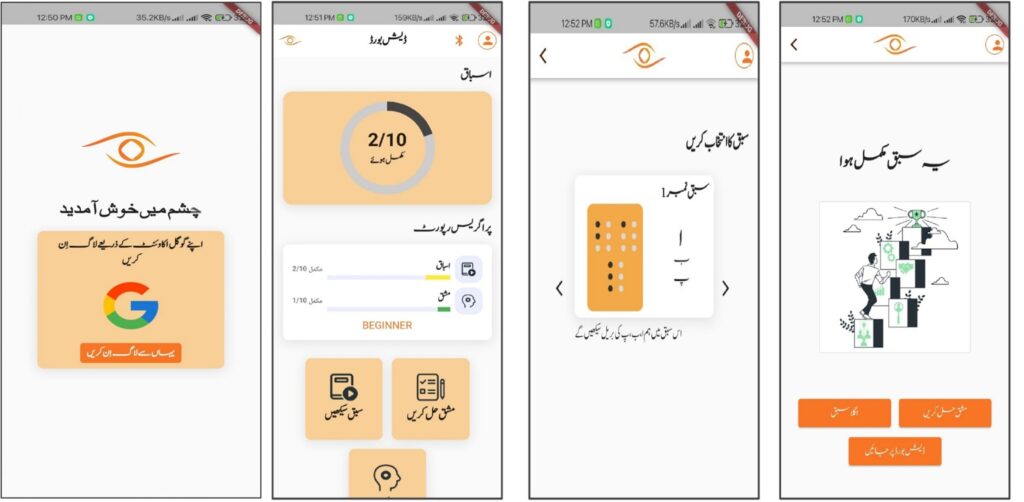
The login and dashboard of Chasham app as shown in figure 1, provides the user with a variety of distinct options. These include a progress report that details the completed lessons and exercises, as well as the student’s proficiency level, which can be classified as beginner, intermediate, or advanced. In addition to these, the dashboard includes additional features such as the ability to solve exercises, participate in lesson-based learning, and access the database entry section. These options, taken together, provide users with a comprehensive and customizable experience, allowing them to track their progress, select their learning path, and explore further within the application.
2. The Braille Display Hardware
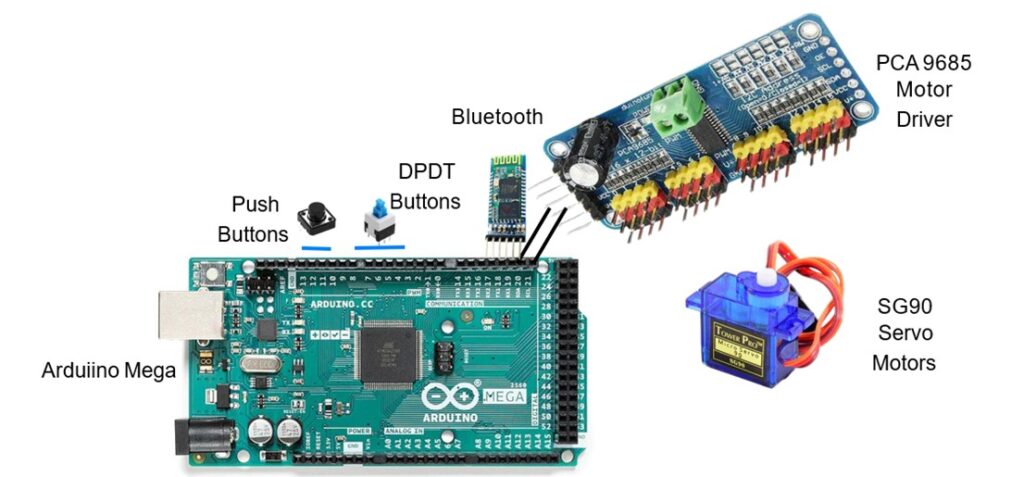
The circuit implementation is a vital aspect of our Braille learning device as it integrates multiple components and modules to form a functional and user-friendly system. The Arduino Mega microcontroller board, utility buttons, Braille input module, PCA9685 motor driver, HC-05 Bluetooth module, and external power supply are integrated to provides seamless interaction, accurate Braille input, precise motor control, and wireless connectivity with the mobile application. By understanding the role and interaction of each component, the reliability and efficiency of the device can be better appreciated.
Energy-efficient: dots stay raised without continuous power.
Compact: multiple cells fit in a tablet-like device.
Durable: fewer moving parts mean longer life.
3. The Learning Loop
- Hear: The app announces a letter or word.
- Feel: The braille cells raise the corresponding dots.
- Play: The student interacts by answering questions or completing challenges.
- Reward: Success is celebrated with points, sounds, or new levels
Why Gamification Matters
Gamification is more than just fun. Research shows that games improve engagement, memory retention, and motivation. For visually impaired children, gamification adds three key benefits:
- Motivation: Rewards and feedback encourage persistence even when lessons are difficult.
- Confidence: Small wins help students build belief in their abilities.
- Inclusion: A game-like system mirrors the interactive experiences of sighted peers, reducing feelings of isolation.
By turning literacy into a game, children are not just learning, they’re enjoying the process of discovery.
Impact for Pakistan
The Advanced Urdu Language Tutor could have a transformative impact in Pakistan:
- Affordable literacy: By leveraging local manufacturing and open-source designs, the cost per device can be reduced dramatically.
- Cultural relevance: The system is built around Urdu braille, unlike imported solutions that often focus only on English.
- Educational equity: Schools for the blind in cities like Karachi, Lahore, and Peshawar could equip classrooms with these tablets, ensuring every student has access to braille learning.
- Empowerment: Literacy is the foundation of independence. With braille literacy, students gain access to higher education, employment, and active participation in society.
Future Development and Roadmap
While the current prototype focuses on alphabets and simple words, the future roadmap includes:
- Full-page braille displays using open-source 3D printed braille cells to make entire sentences and paragraphs readable.
- Gamified storybooks in Urdu: interactive adventures where children unlock new characters and challenges by reading.
- Adaptive difficulty levels: AI-assisted tracking to personalize lessons to each student’s pace.
- Offline mode: ensuring rural schools without stable internet can still benefit.
These improvements will make the system even more cost-effective, scalable, and engaging.
Conclusion
The Gamification-based Advanced Urdu Language Tutor is more than an educational tool. It is a step towards inclusive, joyful, and empowering literacy for visually impaired children in Pakistan.
By blending audio lessons, tactile braille hardware, and gamification, this initiative brings back the fun and curiosity of learning. It offers every child the chance to say proudly, “I can read Urdu in braille.”
With support from educators, NGOs, and policymakers, this vision could become a nationwide reality transforming classrooms and giving thousands of visually impaired children the key to literacy, independence, and opportunity.
The author is an Assistant Professor at School of Electrical Engineering and Computer Science (SEECS), National University of Sciences and Technology (NUST). She can be reached at [email protected].