


In modern warfare, reliable communication networks are vital, but they can be crippled by targeted jamming of critical nodes. Our system called jamBIT, uses AI and deep reinforcement learning to identify and disrupt these critical nodes in real time.
a. Background
In the age of digital warfare, the side that controls communication often controls the outcome. Military units rely on Mobile Ad-hoc Networks (MANETs ) — flexible, self-healing networks that allow troops to share vital information without relying on fixed infrastructure.
These networks are fast to deploy, but they’re not invincible. One of the most effective cyberwarfare tactics is jamming — cutting off communication by targeting critical points in the network. The tricky part? Finding those key points is like finding a few weak links in a chain made up of hundreds of moving parts. It’s a tough computational challenge, especially when every second matters.
b. Objective
Our mission was to develop a smart, AI-powered framework that can:
- Identify the most important nodes in a battlefield network.
- Jam them efficiently to cause maximum disruption.
- Adapt to changing network conditions instantly, whether the network is small or spans hundreds of devices.
c. The Gap in Current Research
While there are tools for jamming networks, most have serious drawbacks:
- Too slow to adapt when the network changes.
- Limited scalability, performing poorly as the network grows.
- Often tied to older communication protocols, making them less effective for modern setups like Named Data Networking (NDN).
We needed something faster, smarter, and ready for the networks of tomorrow.
d. Novelty of Research?
The battlefield of tomorrow demands smarter, more adaptive solutions—and JamBIT (Jammer in Battlefield for Information Targeting) is here to deliver. As the first solution to seamlessly combine deep reinforcement learning with an encoder-decoder neural architecture, JamBIT doesn’t just jam communications—it thinks, learns, and adapts in real-time. By leveraging cutting-edge network topology embeddings, it creates a dynamic “map” of the battlefield’s information landscape, while its compatibility with the secure and efficient NDN protocol ensures robust performance in critical scenarios. The results speak for themselves: proven improvements over existing tools with up to 24% better performance in certain battlefield conditions. In an era where information dominance can determine the outcome of conflicts, JamBIT represents a quantum leap forward in intelligent electronic warfare capabilities.
e. NUST’s Role and the Team Behind It
This project was led by Muhammad Salman, as Principal Investigator along Ali Hassan, Muhammad Yasin, Kiran Khurshid from the College of Electrical & Mechanical Engineering (CEME), National University of Sciences and Technology (NUST), Islamabad. The international collaborators include Taehong Lee – Korea Institute of Energy Technology (KENTECH), South Korea and Youngtae Noh – Hanyang University, South Korea.
NUST provided the core AI design, model training, and extensive performance testing in simulated battlefield conditions.
f. Why It Matters for Pakistan
JamBIT strengthens Pakistan’s digital defense capabilities by:
- Giving our armed forces a locally developed, scalable jamming solution.
- Reducing dependence on foreign defense tech.
- Providing a platform that can also secure civil emergency networks, IoT infrastructures, and critical communications during disasters.
g. Inside the System
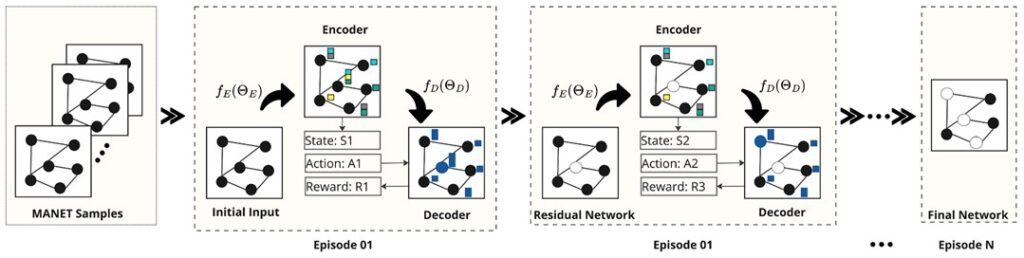
Imagine a constantly shifting battle map. JamBIT “reads” that map, scores the importance of each node, and instantly decides which ones to target.
Core components:
- Encoder: Compresses the network’s current structure into a usable digital format.
- Decoder: Predicts which nodes are the best jamming targets.
- Reinforcement Learning Engine: Learns over time to make even better decisions.
h. Key Results
In tests, JamBIT showed:
- 24% improvement in small connected-node networks (50–100 nodes).
- 8% gain in large connected-node networks (400–500 nodes).
- 7–15% improvement in network dismantling across sizes.
- It adapts quickly and maintains performance even in unpredictable conditions.
i. Looking Ahead
We see JamBIT as more than just a battlefield tool. Potential collaborations include:
- Defense and cybersecurity agencies.
- IoT and industrial network security teams.
- Research labs working on NDN protocol optimization.
Conclusion
By merging AI and military communication strategy, JamBIT gives Pakistan a cutting-edge advantage in securing — and if needed, disrupting — complex networks of the enemies. It’s a leap forward not just in defense tech, but in national self-reliance.
The author is an Assistant Professor at College of Electrical and Mechanical Engineering, National University of Sciences and Technology (NUST). He can be reached at [email protected].
Research Profile: https://bit.ly/4oUekd4