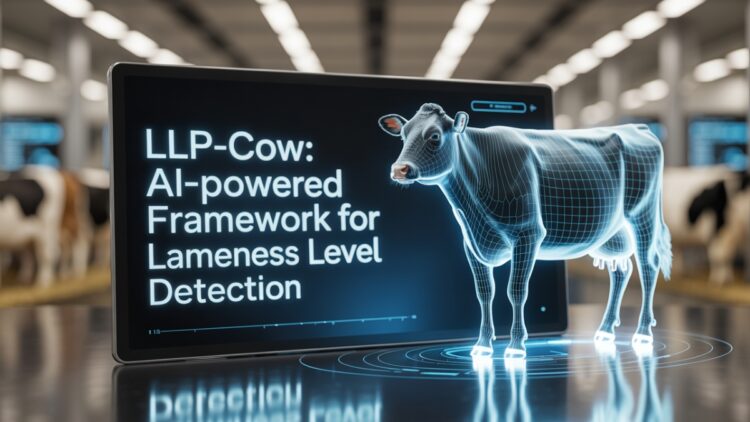

Lameness is one of the most common illnesses in dairy animals which is responsible for affecting millions of dairy animals resulting in degradation in their health and productivity. Early detection of lameness is especially challenging in large herds which are used for industrial production of meat and dairy products owing to the continuous nature of the illness. By segregating such animals from the herd not only improves the productivity of overall herd but it is also helpful for the animal itself. With LLP-Cow, we aim to segregate the affected animal early [Figure 1] to start its treatment.
![Figure 1: A cloud-based AI-powered framework is utilized to categorize an animal into healthy or lame [1]](https://researchblog.nust.edu.pk/wp-content/uploads/2025/08/Figure-1-3.jpg)
Major challenge in lameness detection and state-of-the-art approaches
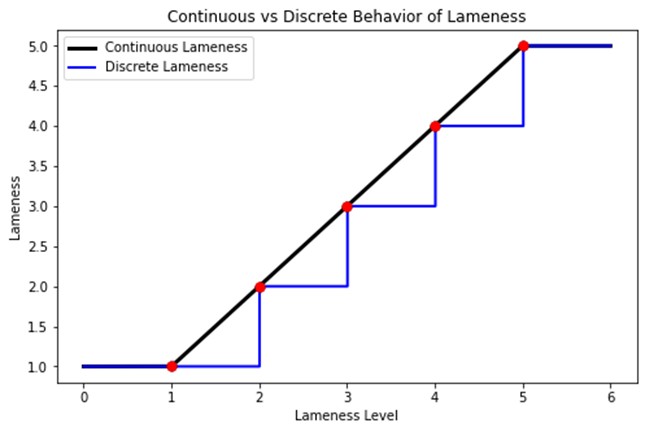
Lameness is a continuous condition which progressively increases as shown with black curve in Figure 2. However, for an AI-based system, it is generally discretized for classification purposes to make a decision whether to keep animal in herd or not. Generally, lameness is divided into five levels as shown by red dots in Figure 2. An animal with lameness level 1 represents a normal and healthy animal. From 2-5, we have lameness of various categories with 2 being the moderate one. But from 3-5, animal visibly demonstrates the hindrance in its ability in performing various activities. This conversion of continuous function of lameness to discrete one represents the first major challenge in lameness detection.
![Figure 3: A camera-based imaging system for lameness detection [2]](https://researchblog.nust.edu.pk/wp-content/uploads/2025/08/Figure-3-1.jpg)
Generally, lameness is categorized by the vets during the live session. However, manual categorization is time-intensive and resource-intensive process. To automate this process, camera-based systems are generally used [Figure 3]. These systems are being deployed for lameness detection. However, they suffer from high computational and financial costs related to them. Another limitation is their inability to observe animals in their natural habitat.
Novelty of the introduced technique
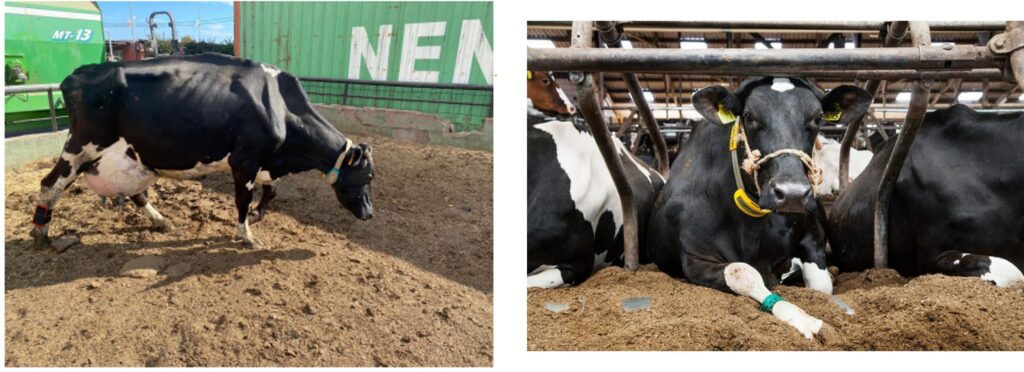
Major novelty of our approach is to use sensors which can record animal behavior continuously. For this purpose, an Apple iWatch is attached to the leg of an animal. Both front and hind legs can be used for this purpose as shown in Figure 4. The choice of watches is based on substantial memory available which is used to record signals related to animal posture and motion. For our study, we utilized signals from gyroscope, accelerometer, and magnetometer [1].
![Figure 5: Block diagram of the system utilized for lameness detection [3]](https://researchblog.nust.edu.pk/wp-content/uploads/2025/08/Figure-5-1-1024x252.jpg)
In Figure 5, major modules of the system are highlighted as feature extraction, deep neural network, and majority voting. Instead of giving raw signals as input, we utilized time-frequency, and statistical features to capture characteristics related to posture and motion. To make the system fit for real-time monitoring, we utilized a deep neural network composed of 2D convolutional neural network. Here, input to CNN along the y-axis are features with x-axis representing the time stamps for each feature. To make our system robust, we utilized a majority-based voting system. With small size and F-1 score of 94%, LLP-Cow can be deployed for real-time applications.
Future Perspectives
Although the system developed is designed for cows, it is equally applicable to other quadrupeds such as horses, sheep, and goats. In future studies, a digital monitoring device—such as a smartwatch or dedicated sensor—can be attached to the animal under observation to collect a variety of physiological and behavioral predictors. These measurements can then be processed using the proposed setup to assess the animal’s overall health status. For instance, in the case of horses used in recreational sports, early detection of stress, fatigue, or lameness can help prevent injuries, optimize performance, and ensure animal welfare. Similarly, in sheep and other livestock, such continuous health monitoring can contribute to improved productivity, reduced veterinary costs, and enhanced well-being.
References:
[1] Ismail, Shahid, et al. “CowScreeningDB: A public benchmark database for lameness detection in dairy cows.” Computers and Electronics in Agriculture 216 (2024): 108500.
[2] Zhang, Ruihong, et al. “Lameness Recognition of Dairy Cows Based on Compensation Behaviour Analysis by Swing and Posture Features from Top View Depth Image.” Animals 15.1 (2024): 30.
[3] Ismail, Shahid, Moises Diaz, and Miguel Angel Ferrer. “Deep learning for lameness level detection in dairy cows.” Engineering Applications of Artificial Intelligence 151 (2025): 110611.
The author is an Assistant Professor at College of Electrical and Mechanical Engineering, National University of Sciences and Technology (NUST). He can be reached at [email protected].
Research Profile: http://bit.ly/4oUC7cW