

Motorway closures during foggy season are a major obstacle for those who need to travel by road for urgent matters. The season lasts for two to three months, and the motorway is closed for over 12 hours a day. This problem intrigues us to propose a solution where we can benefit from vehicular communications by integrating software-defined networking (SDN), thus creating a software-defined vehicular network (SDVN) that can address the issue and provide safe travels over hazy motorways.
The research involves a single main controller (MC), an optimal controller (OC), and multiple local controllers (LCs) selected from roadside units (RSUs). Any signboard, cameras, streetlamps, etc. can serve as RSUs. Hence, the MC can be a toll booth, a motorway police office, or a parked police car. The MC is responsible for maintaining the global state of the SDVN, while the LCs handle the local states. LCs keep the local states in their flow table and update the MC with their states periodically to ensure the global state is maintained. In the local state, the status of vehicles that are within the communication range of an LC is recorded. This involves vehicle ID, position, speed, time, and road visibility conditions.
We do not categorize all RSUs as LCs because installing SDN switches on all RSUs is costly for the network. Therefore, using a machine learning algorithm, the MC selects those RSUs as LCs that are located at locations where connectivity between vehicles is guaranteed. Moreover, due to the consideration of a critical issue that involves the exchange of alarming messages between vehicles, it is necessary to introduce an OC at the same level where LCs are located. The OC is instrumental in our research, as it shares the burden of the MC, sends alarming messages to vehicles about speed reduction and lane change, and only selects necessary LCs in the optimal path.
Our goal is to provide a safe and stable optimal routing path that considers road visibility conditions and facilitates communication between vehicles. Vehicles receive alarming messages through the optimal path provided by the OC, which ensures safe and stable communications and allows them to reduce their speed or switch lanes before reaching low-visibility roads. By ensuring vehicle connectivity, this path reduces communication delay and overhead, enabling them to stay up to date on their current status while traversing fog-shrouded roads. The dedicated short-range communication (DSRC) band is utilized for this communication. Utilizing DSRC and integrating SDN for vehicular communications on fog-shrouded roads is what makes this research novel.
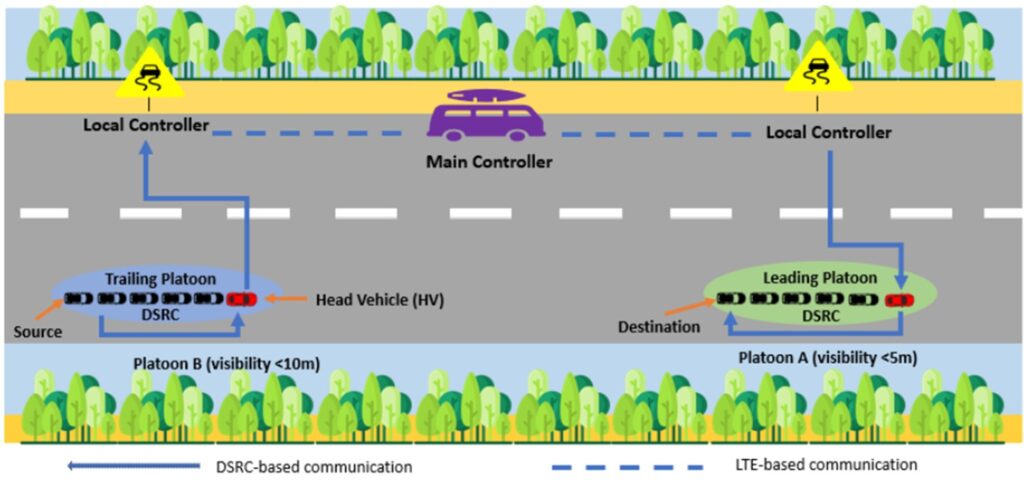
The simulations were conducted in the network simulator to simulate the movement of different platoons on foggy highways. During foggy seasons, vehicles often follow each other and maintain a consistent speed, which results in the formation of platoons. Therefore, we considered an example scenario where the head vehicle from platoon B at its current location (see Fig. 1) was asking about the condition of the road from platoon A, so that platoon B could maintain its speed ahead according to visibility conditions. The OC, along with the appropriate LCs, aided platoon B in obtaining this information from platoon A. By maintaining connectivity, we ensured safety and stability by achieving high delivery ratio, less delay, and less overhead.
As part of our future endeavours, we will take into account the psychological characteristics of drivers when selecting the head vehicle to ensure that people capable of driving without stress on foggy roads can lead the platoon. Additionally, by taking advantage of the high data rates of 6G technologies, we intend to test how this network performs in millimetre wave and terahertz bands in the near future. Furthermore, our future work involves ensuring the security of this safe and stable 6G SDVN network to prevent malicious activity.
NUST contribution (name of PI and team members): The study was supervised by Dr. Huma Ghafoor, with contributions from a MS student Hafiza Zunera Abdul Sattar, along with three UG students, Fatima Sohail, Ayesha Khanum, and Muhammad Rehan Basharat.
Acknowledgement: This work was supported by the NUST Grant for Young Researchers under grant number NUST-22-41-65.
The author is an Assistant Professor at the Department of Electrical and Computer Engineering, School of Electrical Engineering and Computer Science (SEECS), National University of Sciences and Technology (NUST). She can be reached at [email protected].
Research Profile: https://bit.ly/4cHqBvL