

Background: Why Data Security Matters in 6G
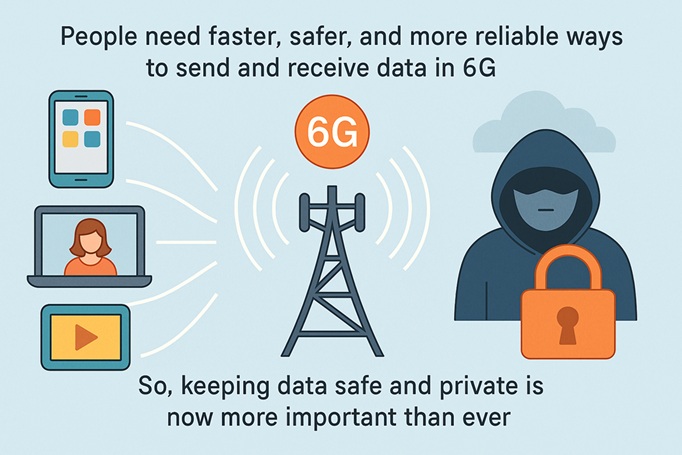
People need faster, safer, and more reliable ways to send and receive data in 6G. Every day, we use smart devices, video calls, and online apps that require a strong internet. Older networks can’t always handle this. That’s why new smart networks are being used; they can find and use free space in the air to work better. But as these networks get smarter, there’s also a bigger risk that someone might secretly steal the data. So, keeping data safe and private is now more important than ever.
The Problem: Eavesdropping and Poor Spectrum Usage
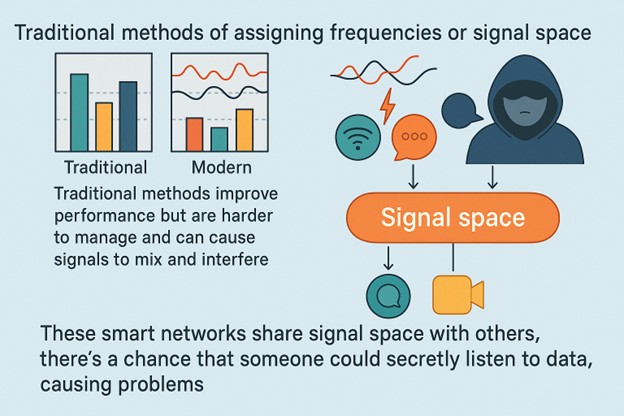
The main problem is that traditional methods of assigning frequencies or signal space don’t use bandwidth efficiently. On the other hand, more modern approaches improve performance but are harder to manage and can cause signals to mix and interfere. Also, since these smart networks share signal space with others, there’s a chance that someone could secretly listen to the data. This makes it harder to keep information private and safe. If the signal space isn’t shared properly, some parts may go unused, while others may have too many users at once, causing problems.
The Work Done: A Smarter, Safer Network Approach
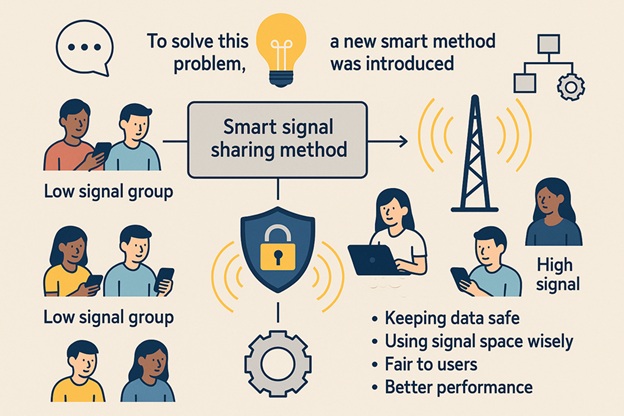
To solve this problem, a new smart method was introduced. In simple words, it cleverly combines the old and new ways of sharing signals to get better results. It puts users into groups based on how strong their signals are and then chooses the best way for each group to share the signal space. The goal is to keep the data safe from people who try to secretly listen. This method uses smart calculations and a special step-by-step solving trick to make everything work well. When tested, it showed much better results in keeping data safe, using signal space wisely, treating users fairly, and improving overall performance compared to old methods.
Benefits and Applications: Who Can Use This and Why It Helps
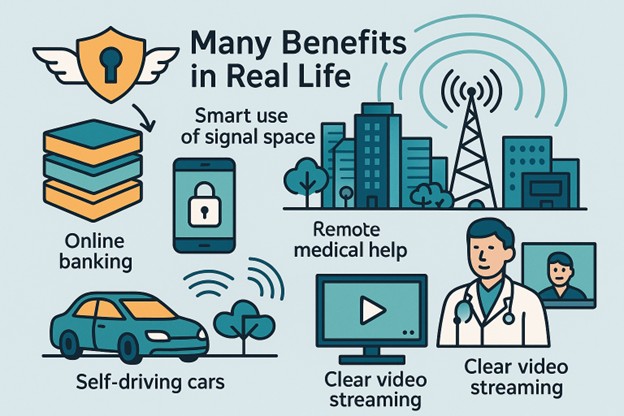
This method has many real-life benefits. It helps keep data safe, which is very important for things like online banking, government work, or hospitals. It also uses signal space more wisely, so more devices can connect without problems. It can be used in smart cities, self-driving cars, remote medical help, and clear video streaming. It not only makes the connection faster and more stable but also makes sure everyone gets a fair share of the network, even in busy cities. This method can also grow easily to support more towers and users as 6G spreads.
Future Collaboration: What’s Needed Next
Although the results look good, moving forward will need teamwork between scientists, phone companies, and government bodies. The method still needs to be tested more in real-life situations to make it better for different places. Using this system in big projects like smart cities or national security will need everyone to work together. Also, as online threats keep growing, experts must keep improving ways to keep data safe. This work is a big step in the right direction, but making 6G networks safe for all will only happen if everyone works together.
The author is an Assistant Professor at the Military College of Signals (MCS), National University of Sciences and Technology (NUST), Islamabad, Pakistan. He can be reached at
[email protected].