
The Problem We Face
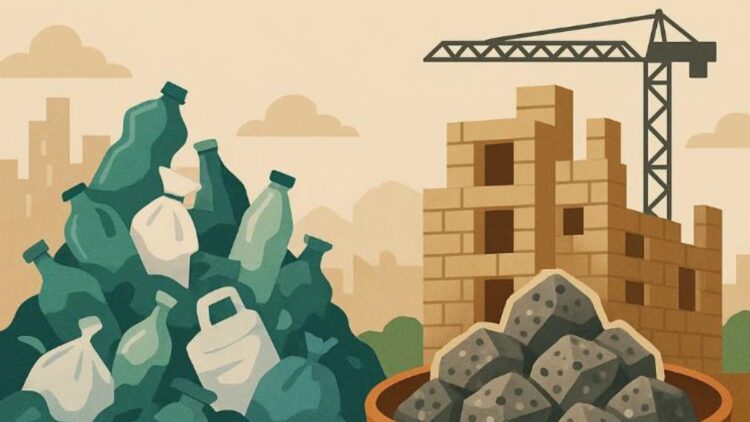
Imagine walking down any street in Pakistan and counting the plastic bottles, bags, and containers you see. Now multiply that by millions across the globe. Every year, the world produces 400 million tons of plastic waste, but only 9% gets recycled. The rest? It clogs our landfills, pollutes our oceans, and threatens our environment for centuries.
At the same time, the construction industry has an equally massive problem. Building concrete structures requires enormous amounts of natural stone and gravel – over 50 billion tons annually worldwide. This demand is literally moving mountains, destroying habitats, and depleting our planet’s natural resources at an alarming rate.
What if we told you there’s a way to solve both problems with one innovative solution?
A Game-Changing Discovery
Researchers at NUST Institute of Civil Engineering (NICE) have developed a groundbreaking technology that transforms plastic waste into high-quality building materials. Instead of letting plastic bottles rot in landfills for 500+ years, they’ve found a way to give them a second life as concrete aggregates – the rocky bits that make concrete strong.
But here’s where it gets interesting: previous attempts to use plastic in concrete often failed because smooth plastic pieces didn’t bond well with cement, making the concrete weak. The NUST team cracked this code by creating something entirely new – sand-infused plastic aggregates.
The Secret Recipe
Think of it like making the perfect energy ball. Instead of using pure plastic (which is like using only nuts), the researchers mixed plastic waste with sand in a 1:1 ratio, creating a textured, fibrous material that grips onto cement much better than smooth plastic alone.
The process is surprisingly straightforward:
- Collection: Gather polypropylene plastic waste (the type used in bottle caps and food containers)
- Mixing: Combine with sand in equal proportions
- Heating: Use an extruder machine at 220°C to melt and blend the mixture
- Shaping: Pour into molds to create brick-like forms
- Crushing: Break down into aggregate-sized pieces perfect for concrete
The magic temperature of 220°C is crucial – hot enough to melt the plastic effectively, but cool enough to prevent harmful gas emissions.
Remarkable Results
The performance results are nothing short of impressive. When 30% of traditional stone aggregates were replaced with these sand-infused plastic aggregates, the concrete retained 84.5% of its original strength – strong enough for structural buildings like houses and offices.
Even more fascinating, the concrete made with 100% plastic aggregates, while 52% less strong than traditional concrete, is still perfectly suitable for non-structural applications like paving blocks, sound barriers, and decorative elements.
But strength isn’t the only benefit. The plastic-infused concrete showed a 37% improvement in water resistance, potentially making buildings more durable and long-lasting. Under the microscope, researchers observed that the fibrous texture of the sand-plastic aggregates created better bonding with cement compared to smooth natural stones.
Environmental Game-Changer
Perhaps the most exciting aspect of this research is its environmental impact. A comprehensive Life Cycle Assessment revealed that using sand-infused plastic aggregates could reduce concrete’s carbon footprint by an astounding 54.83% when replacing just 30% of natural aggregates.
To put this in perspective: if Pakistan’s construction industry adopted this technology for even 10% of new concrete structures, we could divert thousands of tons of plastic waste from landfills while dramatically reducing the environmental impact of construction.
Real-World Applications
This isn’t just laboratory science – it’s ready for real-world implementation. The technology is particularly suited for:
- Residential construction using 30% replacement for structural elements
- Infrastructure projects like sidewalks, curbs, and median barriers using higher replacement levels
- Precast concrete products such as paving stones and decorative blocks
- Sound barriers along highways, taking advantage of plastic’s natural acoustic properties
Looking Forward
The research team, led by faculty from NUST’s School of Civil and Environmental Engineering, envisions a future where plastic waste becomes a valuable resource rather than an environmental burden. Their next steps include testing long-term durability under Pakistan’s diverse climate conditions and exploring the technology’s potential with mixed plastic waste streams.
A Model for Sustainable Innovation
This breakthrough exemplifies how Pakistani research institutions are leading global efforts toward sustainability. By addressing two critical challenges simultaneously – waste management and resource depletion – NUST researchers have created a technology that could transform both the construction and waste management industries.
The implications extend far beyond Pakistan’s borders. With similar plastic waste and construction challenges worldwide, this sand-infused aggregate technology could become a global solution for sustainable development.
As we face an uncertain environmental future, innovations like these remind us that the solutions to our biggest challenges often lie not in doing less, but in doing things differently. Sometimes, the trash of today becomes the treasure of tomorrow.
The author is an Assistant Professor at School of Civil and Environmental Engineering (SCEE), National University of Sciences and Technology (NUST). He can be reached at [email protected].