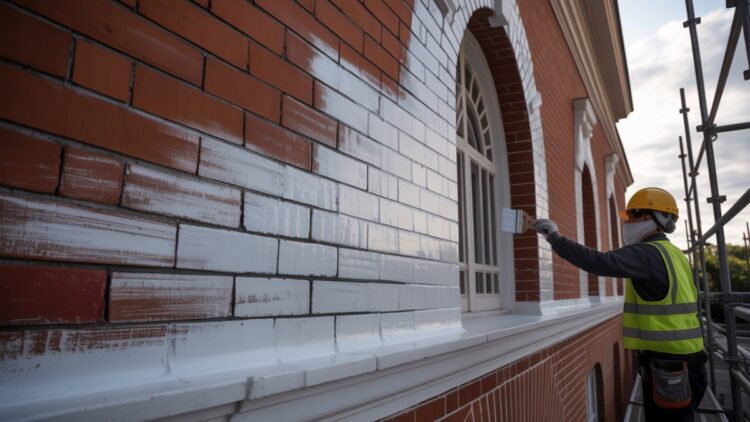


Heritage masonry buildings are among the most vulnerable structures during earthquakes. Their cultural and historical importance makes preserving them a global priority, yet their structural limitations pose serious risks to human safety. Traditional strengthening methods, such as reinforced concrete jacketing or steel bracing, often alter the architectural identity of these buildings, which is not acceptable in most conservation practices.
In recent years, researchers have explored innovative solutions to strengthen heritage masonry structures without compromising their aesthetics or authenticity. One such solution is the use of fiber-reinforced paint (FRPnt), a thin, lightweight, and visually unobtrusive coating applied directly to masonry surfaces. In our latest study, we investigated the effectiveness of this technique through both numerical simulations and shake table testing, aiming to validate its ability to improve energy dissipation, delay damage, and enhance overall safety.
Why Fiber-Reinforced Paint?
Conventional strengthening systems such as carbon fiber reinforced polymers or steel meshes provide significant structural improvements but require major interventions, which are often unsuitable for heritage sites. Fiber-reinforced paint, in contrast, uses fibers dispersed in a polymer matrix applied as a coating.
This system offers several advantages:
- Aesthetic Preservation: It does not significantly alter the external appearance of masonry.
- Lightweight Application: No major changes in mass or stiffness are introduced.
- Ease of Installation: The technique can be applied like regular paint, requiring minimal invasive work.
- Cost-effectiveness: It is less expensive compared to conventional retrofitting solutions.
These features make FRPnt particularly attractive for heritage conservation projects, where maintaining historical authenticity is as important as improving safety.
Numerical Validation: Modeling Energy Dissipation
To evaluate the potential of fiber-reinforced paint, we first carried out numerical modeling using ABAQUS, a finite element analysis software. The models simulated unreinforced masonry (URM) and fiber-reinforced masonry (FRM) walls under cyclic and dynamic loading . The results were promising. The FRM walls demonstrated a substantial increase in energy dissipation capacity, delaying the onset of cracks and reducing the rate of stiffness degradation. The paint acted as a protective layer that redistributed stresses across the masonry units, preventing early localized failures.
In particular, the models showed:
- Delayed Cracking: FRM walls resisted visible cracking up to nearly four times longer than unreinforced walls.
- Improved Ductility: The strengthened models exhibited smoother load–displacement responses.
- Enhanced Collapse resistance: Numerical predictions indicated that FRM could extend the survival of structures under seismic loads.
Experimental Validation: Shake Table Testing
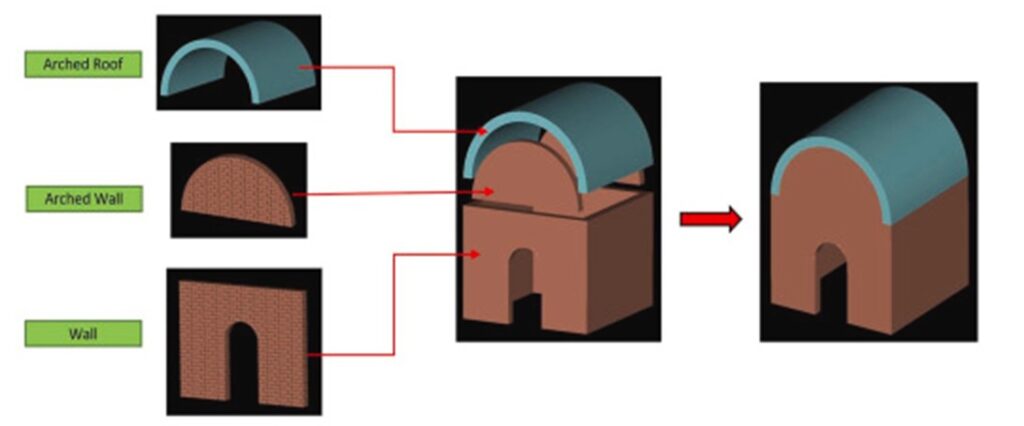
Numerical predictions alone cannot capture the full complexity of seismic behavior, so we conducted scaled shake table experiments to validate the models. Scaled masonry structures were prepared, with one left unreinforced and another coated with fiber-reinforced paint. Both were subjected to gradually increasing seismic excitations.
The findings reinforced our numerical observations:
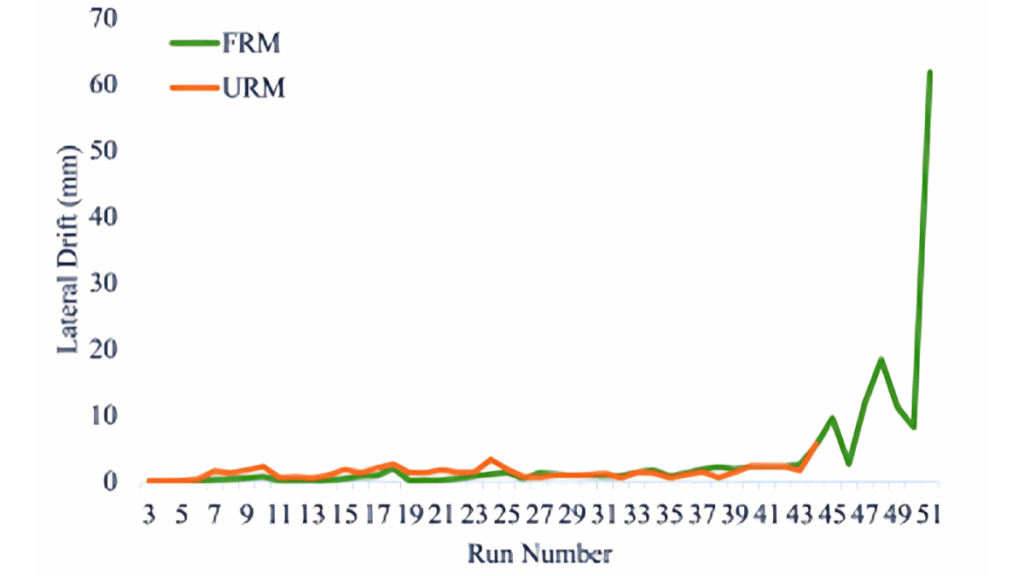
- The unreinforced model (URM) began to crack early and collapsed at a lower excitation level.
- The fiber-reinforced model (FRM) exhibited cracks much later, sustained more seismic runs, and withstood higher intensities before collapse.
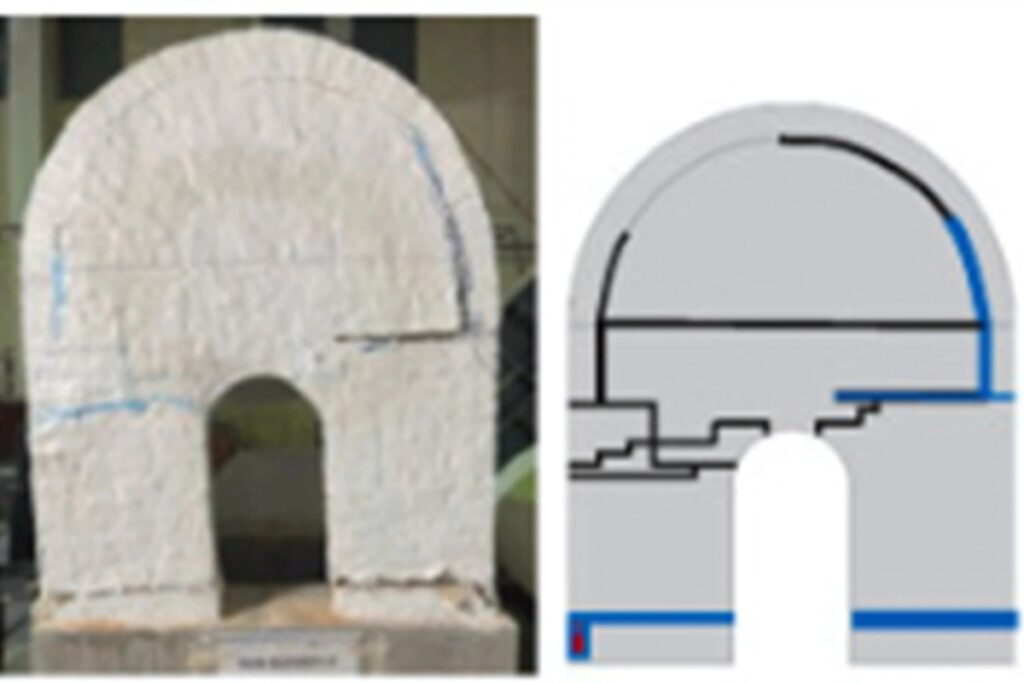
- Importantly, the arch masonry roof of the FRM remained intact until the end, demonstrating that the fiber-reinforced paint provided full protection to this critical element.
Quantitatively, the unreinforced model collapsed at run 44, while the strengthened model lasted until run 52. Cracking began at run 10 for URM but was delayed until run 39 for FRM. These results highlight the remarkable ability of fiber-reinforced paint to extend the functional life of masonry during seismic activity.
Implications for Heritage Preservation
The study demonstrates that fiber-reinforced paint is not only a viable but also a practical solution for strengthening heritage masonry buildings against earthquakes. Unlike traditional retrofitting techniques, it offers a non-intrusive, lightweight, and reversible option. For communities in seismic regions rich in historical structures, such as South Asia, Europe, and the USA, this technique holds immense promise. It provides a way to safeguard both cultural heritage and human lives without compromising authenticity. Furthermore, because of its simplicity and cost-effectiveness, the method can be scaled for widespread application even in resource-constrained regions.
Conclusion
Heritage masonry buildings embody cultural memory, architectural identity, and historical continuity. Protecting them from seismic damage is a pressing challenge. Our study confirms that fiber-reinforced paint significantly improves the seismic resilience of masonry structures, enhancing energy dissipation, delaying damage, and preserving critical components under earthquake loading. Through numerical validation and shake table testing, we have demonstrated that this innovative approach can transform heritage preservation practices. It provides engineers, architects, and conservationists with a powerful tool, one that balances structural safety with historical integrity. As the frequency and intensity of seismic events continue to pose risks worldwide, sustainable and culturally sensitive solutions like fiber-reinforced paint represent a crucial step forward in protecting our built heritage.
Reference
Htet, P. M., Ejaz, A., Gadagamma, C. K., Hussain, Q., Saingam, P., Khaliq, W., … & Suparp, S. (2025). Seismic strengthening of heritage masonry buildings using fiber-reinforced paint: Numerical validation and shake table testing for enhanced energy dissipation and safety. Journal of Building Engineering, 101, 111824. DOI: https://doi.org/10.1016/j.jobe.2025.111824.
The author is an Assistant Professor at National Institute of Transportation, National University of Sciences and Technology (NUST). He can be reached at [email protected].
Research Profile: http://bit.ly/4lUTibt