
Have you ever imagined a system that can treat wastewater, remove salt from seawater, and generate electricity all at the same time? It may sound like something out of science fiction, but scientists are making it a reality. One fascinating innovation that combines biology, chemistry, and renewable energy is the Photosynthetic Microbial Desalination Cell (PMDC).
Our research, “Anode substrate tailoring in fed-batch photosynthetic microbial desalination cell for industrial and domestic wastewater treatment”, explores how this system works in an efficient and sustainable way.
What Is a Photosynthetic Microbial Desalination Cell (PMDC)?
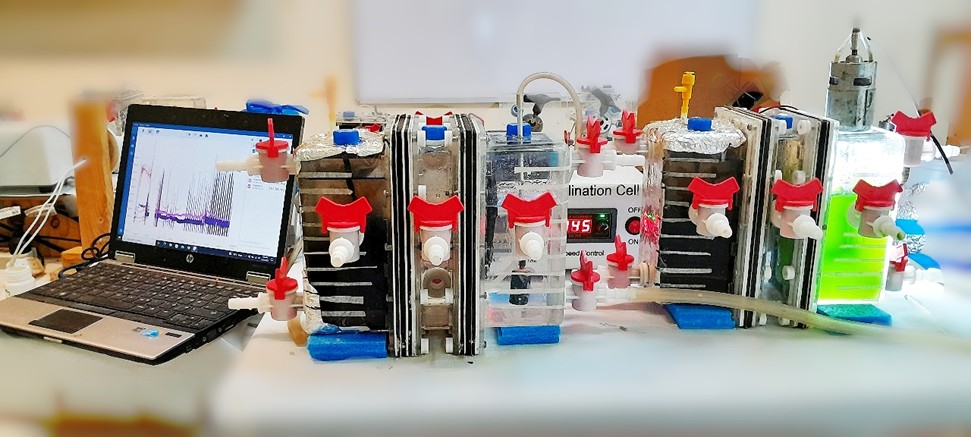
A single Photosynthetic Microbial Desalination Cell (PMDC) can do what usually takes three systems: clean wastewater, desalinate salty water, and produce electricity, using only bacteria and algae as its tiny powerhouses.
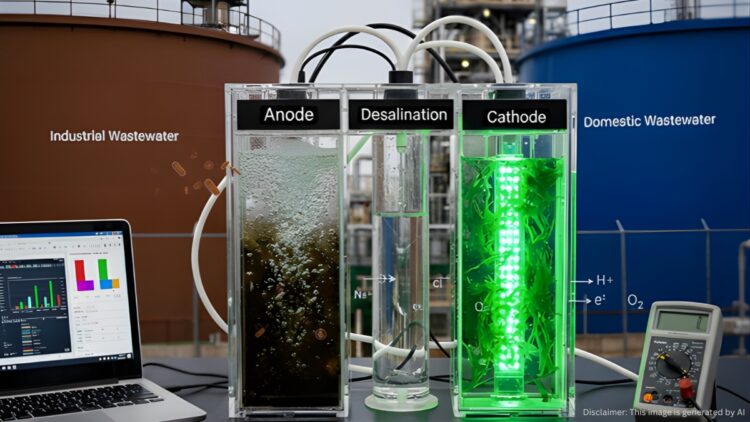
The system has three main chambers:
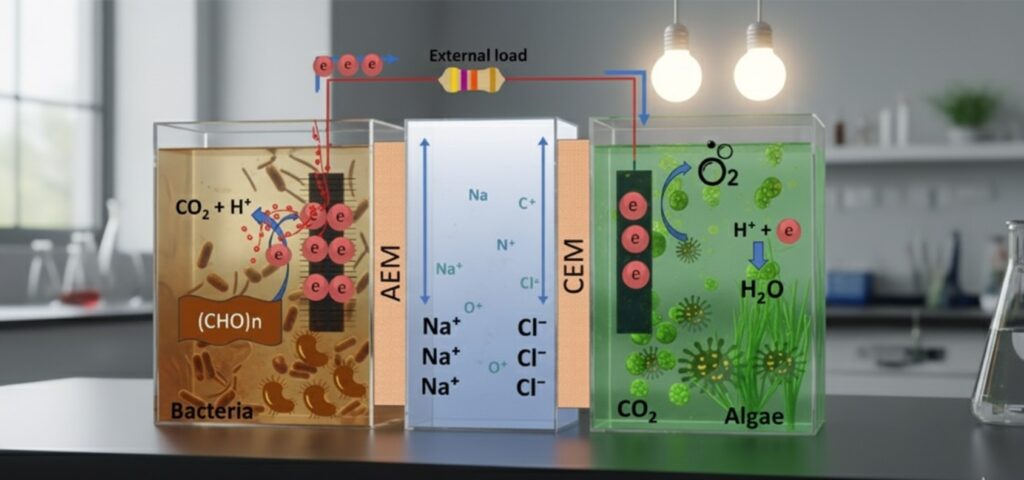
- Anode Chamber: Here, bacteria feed on wastewater, breaking down organic matter and releasing electrons and protons.
- Desalination Chamber: Positioned in the middle, this chamber removes salt from saline or seawater using ion-exchange membranes.
- Cathode Chamber: This section contains photosynthetic microalgae that uses light (sunlight or artificial) to produce oxygen and complete electrochemical reactions.
When bacteria in the anode chamber break down wastewater, they release electrons and protons. The electrons flow through an external wire to generate electricity, while most protons accumulate in the anode. In the cathode chamber, microalgae use sunlight to produce oxygen, driving oxidation-reduction reactions and reducing the need for energy-intensive aeration. The difference in osmotic pressure and electrical potential between chambers move ions in the desalination chamber: chloride (Cl⁻) towards the anode and sodium (Na⁺) toward the cathode. However, some ions re-migrate, slightly reducing desalination efficiency.
Why Use Microalgae?
Microalgae are tiny but powerful allies in this system:
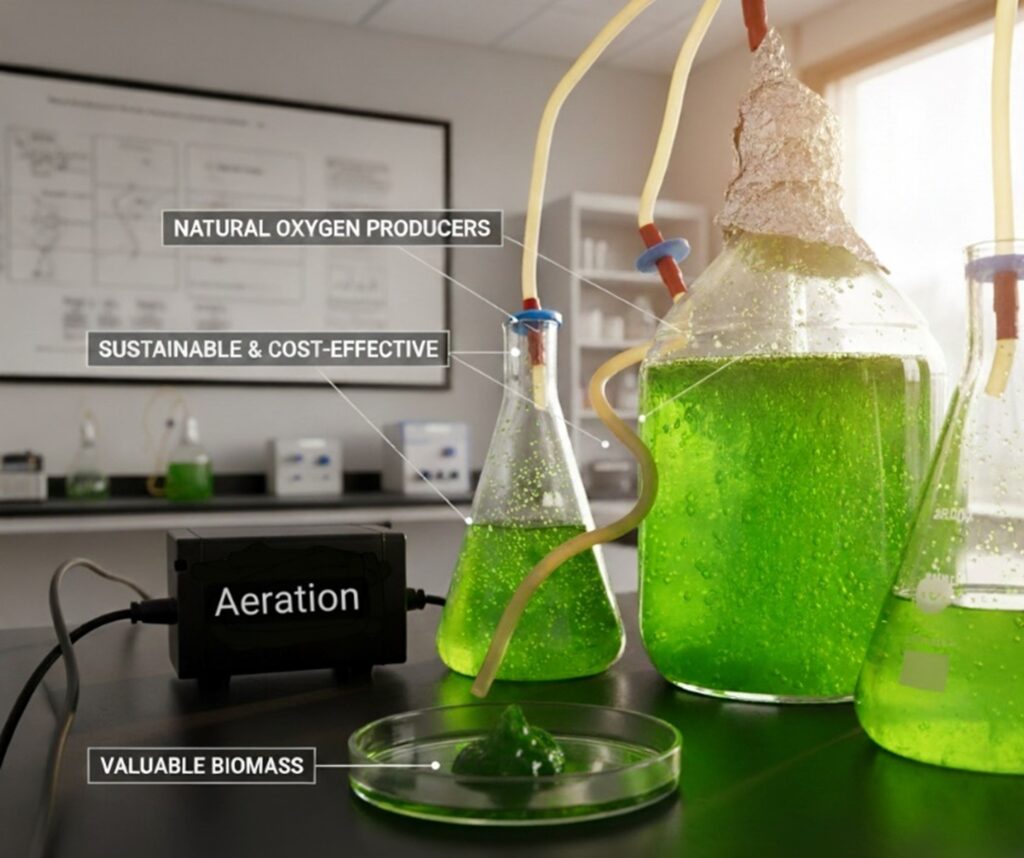
- Natural Oxygen Producers: Through photosynthesis, they release oxygen that drives cathodic reactions, removing the need for external aeration.
- Cost-Effective and Sustainable: Unlike chemical oxidizing agents, algae are inexpensive, easy to grow, and naturally available in most environments.
- Water Purifiers: Microalgae absorb nutrients like nitrogen and phosphorus, letting them grow while simultaneously treating wastewater.
- Additional Benefits: Algal biomass can be reused for biofuels, fertilizers, or feed, promoting a circular, eco-efficient process.
What Did Our Research Focus On?
While PMDCs are highly promising, their efficiency depends significantly on the anode substrate, the material, and the medium that supports bacterial growth and electron production.
Our study aimed to determine how different anode substrate concentrations affect system performance, especially when treating high-strength industrial wastewater. The anode substrate acts as “food” for bacteria, so its composition strongly influences how actively the microbes can grow, form biofilms, and transfer electrons.
To mimic real conditions, we ran the PMDC in fed-batch mode, periodically adding fresh wastewater to observe its adaptation, just like real treatment plants.
Why Sugar Wastewater and Domestic Wastewater?
We used sugar wastewater in the anode chamber for its easily degradable organic matter, providing quick energy for bacteria and boosting power generation, and domestic wastewater in the cathode to nourish algae and clean water, as it contains essential nutrients for algal growth. This dual setup enabled efficient industrial and domestic wastewater treatment and energy generation in a single system.
Challenges and the Road Ahead
Despite promising outcomes, one key challenge remains: the desalination efficiency of PMDCs is still relatively low. This limitation mainly arises from complex ion movements across the membranes and the fact that the only driving force for desalination is the system’s own bioelectric energy; no external energy input is used. As a result, the salt removal rate depends entirely on the internal energy generated by the microbes. Additionally, due to back diffusion, some ions migrate back from the anode and cathode chambers into the desalination chamber, further reducing overall desalination performance.
Operating the system continuously, where wastewater and saline water flow steadily through the chambers, could help improve this efficiency by maintaining stable ion migration and consistent biological activity.
Another key area for improvement is finding alternative, low-cost, and locally available membrane materials. Current ion exchange membranes are often expensive, which limits large-scale applications. Developing affordable membrane with similar or better performance could make technology far more practical.
If these two challenges, low desalination efficiency and high membrane cost, are successfully addressed, the PMDC could truly emerge as a new, game-changing technology in the world of sustainable water and energy solutions.
A Step Toward a Cleaner Future
Our research demonstrates how nature-inspired innovation can solve today’s environmental challenges through one integrated system. This work marks a small yet meaningful step toward a sustainable future, where pollution turns into potential, and science and nature work together to restore balance to our planet.
Video of PMDC Lab
The project was completed by Syeda Safina Ali, MS student at School of Civil and Environmental Engineering, under the supervision of Dr. Zeshan Sheikh. She can be reached at [email protected].
The author is a Professor at School of Civil and Environmental Engineering, National University of Sciences and Technology (NUST). He can be reached at [email protected].